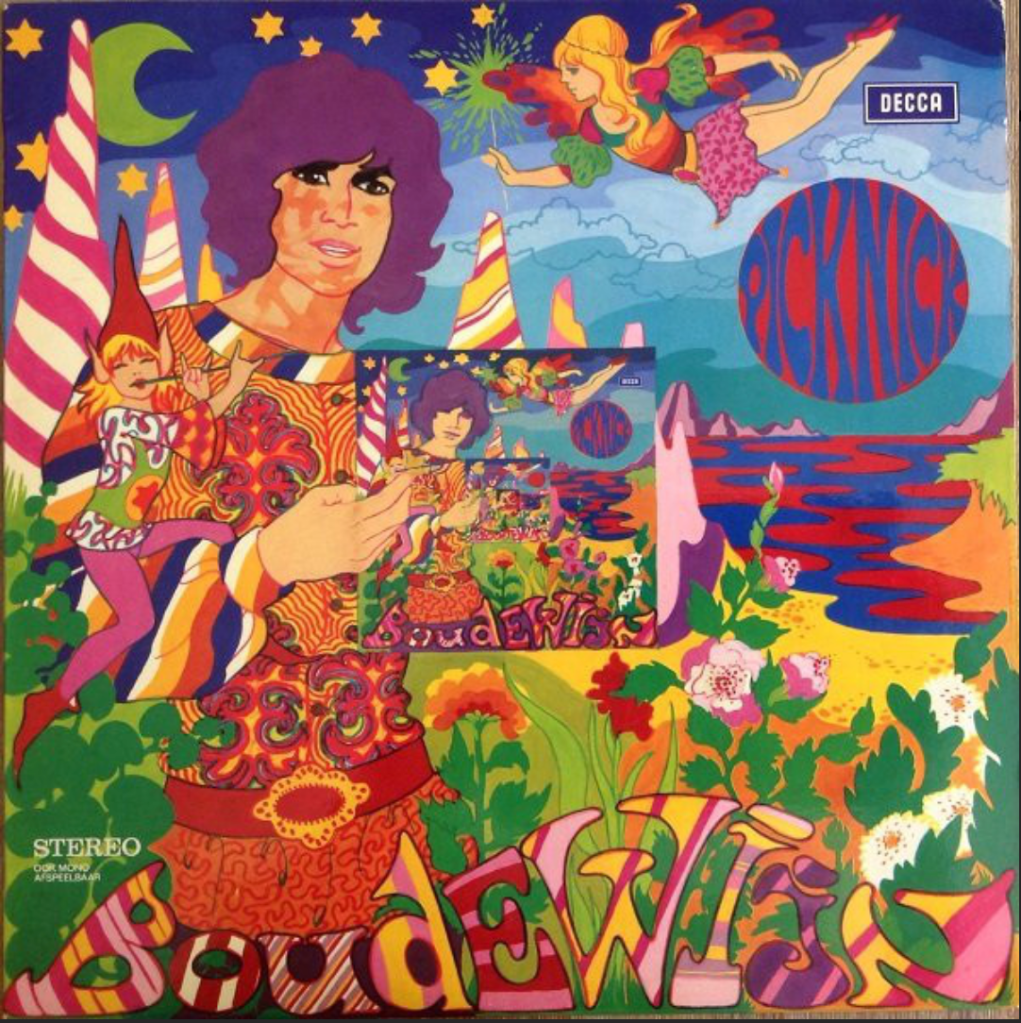
Oz may be a darling of critics and collectors, but I admit that this ‘68 carnival ride of a B-side to “Muffin Man” (Oz’s best-known song and 1st A-side) is the group’s only song I think is really cool. I guess you can chalk it up to the Peter Principle.* By the way, Richard Metzger at Dangerousminds.net says that “Muffin Man” might be “the greatest/goofiest song ever written”. Well, it is certainly goofy. I once played it to my kids to celebrate their consumption of some blueberry muffins. In the Netherlands, the single hit #6, but didn’t hit the top 50 in the UK.
In any event, the band consisted of Brummies who moved to London to seek stardom:
They decided that while Birmingham’s club scene could provide work, it didn’t offer the kind of prospects for a recording career that they had in mind, and so they headed to London. Their songwriting ability got them snatched up by Sparta Music. And for a manager, they had no less a figure than Barry Class, who was best known for his most successful client, the Foundations (of “Build Me Up Buttercup” fame). Class lived up to his last name by setting the group up in a luxury apartment on Park Lane, in London’s exclusive Mayfair district, long a fashionable locale for movie stars and theater performers seeking to put on a big front in their lives. It made for a fair amount of press access and good press, as well as impressing various record company executives, accustomed to dealing with up-and-coming bands living in near squalor.
Bruce Eder, All Music Guide
However, as summed up by John Tracy’s liner notes to their sole album’s CD reissue:
They achieved in a short period of time success — with the likelihood of more to come — that many of their peers in the late-1960s could only dream of, yet for reasons that we’ll probably never know, simply imploded when they needed to sustain.
* According to Investopedia, the principle “is an observation that the tendency in most organizational hierarchies, such as that of a corporation, is for every employee to rise in the hierarchy through promotion until they reach a level of respective incompetence.”
This is the B-side of Christopher’s only single (’70), a biting indictment of ultra-competitiveness in the “whoever dies with the most toys wins” vein.
It appears that Christopher is actually Christopher Neil, who, according to Wikipedia, “is an Irish record producer, songwriter, singer, and actor” who “started in the mid-sixties as a singer with Manchester group the Chuckles.” He produced records for, among others, A-ha, Celine Dion, Cher, Gerry Rafferty, Rod Stewart, Sheena Easton and the Moody Blues. In the ’70s, he played Jesus in Jesus Christ Superstar . . . and later that decade starred in two British sex comedies — Adventures of a Private Eye and Adventures of a Plumber’s Mate (in addition to writing and singing the theme songs). Well, no one can say that he was typecast!
276) The Charles Kingsley Creation — “Summer Without Sun”
Joe Meek produced this wonderful Merseybeat ballad by Welsh brothers Charles and Kingsley Ward. If the November ’65 A-side were written and released a year or two earlier, I’m sure it would have been a big hit in the UK and the U.S. However, everything probably worked out for the best, as after the single flopped, the brothers converted part of their farm into the fabled Rockfield residential recording studios, and the rest (Dave Edmunds, Oasis, Stone Roses . . .) is rock history.
Here is a trailer for the Rockfield Studio documentary:
San Francisco’s Mojo Men were certainly fluid. They were great when they were all men (see #140). They were even better when singer/drummer Jan Errico joined from the Vejtables (see #84), and they thus dropped the “Men” to become simply “Mojo.” “Candle to Burn” is the leadoff track of the Mojo Men’s/Mojo’s first and only album — ‘69’s Mojo Magic (and a single). But as Jud Cost’s liner notes to the Mojo Men comp Sit Down . . . It’s The Mojo Men states, the album was “[s]addled with one of the most hideous album covers in music history — colored blossoms layered over a group mug shot [and it] sank without a trace.” The group folded soon after. A shame, because Mojo Magic was one of the most glorious sunshine pop albums ever released.
274) O.V. Wright — “ Everybody Knows (The River Song)”
“Overton Vertis Wright learned his trade on the gospel circuit with the Sunset Travelers before going secular in 1964.” (Bill Dahl, https://www.allmusic.com/artist/ov-wright-mn0000457807/biography) (see #71). In his hands, the levee doesn’t have to break for the Mississippi River to exert a tragic and inexorable force. Bluesman Mark gets to the core of Wright:
[H]as a singer ever sounded so desolate, so lost, so obsessed with sadness as [O.V. Wright] always did? . . . [H]is songs were often largely tailored to his unique style of “eloquent desolation” . . . . [Wright] always sounded like a man on the edge in songs like . . . “Everybody Knows (The River Song)” . . . & he could wring pathos from every line he sung. And don’t take “eloquent” as meaning he sounded sophisticated. OV was as “country” sounding as any southern soul singer ever got. The eloquence comes from how he phrased the songs, how he found the potential of inherent sadness in any song. OV always sang like he was staring into a vast, cold void. . . . If you haven’t experienced OV Wright’s music, I suggest that you do so. Just make sure you’ve got some good whiskey handy.
Forget Dark Side of the Moon, this triumphant ‘68 B-side to “Midway Down” belongs on the Wizard of Oz soundtrack.
Johnny Wonderling was of French ancestry, born and raised in Queens, New York. In 1968, he wrote “Midway Down” (recorded and released by The Creation in April 1968) and released a version of the song in September 1968 on Loma Records, a sublabel of Warner Bros. His single was the last single to be released on Loma just before their absorption into the Warner Bros. Records label. [The songs] weren’t promoted by the closing recording sublabel.
“Man of Straw” was written by John, Carey Allane, and Ed Goldfluss. Wonderling says the scarecrow was Jesus, but Goldfluss says “there was no religious intent whatsoever.” (Andrew Sandoval’s liner notes to My Mind Goes High: Psychedelic Pop Nuggets from the WEA Vaults). Well, if Goldfluss was right, these are seriously depressing lyrics.
Here is a re-recorded version from his ‘73 album, which I may like even more:
272) The Strawberry Alarm Clock — “Birds in My Tree”
As Bruce Eder says:
[SAC’s] name is as well known to anyone who lived through the late-’60s psychedelic era as that of almost any group one would care to mention, mostly out of its sheer, silly trippiness as a name and their one major hit, “Incense and Peppermints,” which today is virtually the tonal equivalent of a Summer of Love flashback.
But, as I’ve said previously (see #127), the SAC is so much more than “Incense and Peppermints.” In fact, if I were them, I’d be incensed about “Peppermints.” “Birds”, a propulsive track on their first album (’67) and the B-side of their second single (whose A-side, “Tomorrow,” was their second big hit, reaching #23), is one of the many wonderful songs they recorded.
Jeremy says in Unwind with the Strawberry Alarm Clock that:
“Birds In My Tree” features vaguely psychedelic touches in its adventurous melody, lyrical references to drugs* and a new ideal existence, and a real sense of wonder . . . . [It] begins with a tough, distorted guitar-led instrumental intro . . . . But soon it levels out into a calmer psych-pop sound . . . . marrying the strengths of the band (tough electric attack, and blissful pop loveliness) together in one simple song.
* I am not sure what the drug references are (“stretch out your mind”?). Maybe the 60’s were one big drug reference.
Eder tells the story of their first album:
[T]he group had been prevailed upon to record an album around [“Incense and Peppermints”]. The album involved a few changes in the lineup, partly growing out of the fact that the existing membership didn’t have enough songs to fill an LP. They brought in 18-year-old George Bunnell, a . . . musician and songwriter . . . and his collaborator . . . Steve Bartek, who was still in high school at the time. They brought with them a brace of songs [including “Bird”] . . . . Bunnell was so effective that all agreed that he should become a member, and he agreed after initial hesitation over abandoning his current group. Even Bartek, who was only 16, was offered a chance to join, in recognition of his contribution to the album, but because of his age he needed his parents’ permission, which wasn’t forthcoming. . . . The Incense and Peppermints LP ended up coming out astonishingly strong, especially considering the haste with which the album was recorded, and the evolving membership during the recording process. Its number 11 chart placement (the only time one of their LPs actually charted) only affirmed the seemingly charmed nature of the group’s work during the last eight months of 1967. . . . [T]he album proved to be one of the more delightful artifacts of the psychedelic era, a strangely compelling mix of psychedelia, sunshine pop, garage rock, and California harmony.
271) The Human Instinct — “A Day in My Mind’s Mind”
A popular Kiwi band known as the Four Fours went to the Big City (London), changed its name to “the significantly cooler” Human Instinct (Mark Deming in All Music Guide), and released some classic singles, most notably this killer psych track (not to be confused with the Talking Heads’s “Psycho Killer”). Cosmic Mind at Play elaborates:
The band, who hailed from Tauranga on the North Island, had been known as The Four Fours in New Zealand and had had a number of hit singles as well as supporting The Rolling Stones on their March 1966 tour of the country. They changed name when they left for the UK in August of that year, playing a residency aboard the ocean liner Fairsky during its five-week voyage in return for reduced fares to England. Once settled in London, The Human Instinct supported all the major acts of the day and played the likes of The Marquee and Zebra Club, and had a Monday residency at the Tiles Club. The band released three singles on Mercury . . . . They then switched to Deram, a subsidiary of Decca Records, and issued the first of two classic popsike singles in December 1967 . . . . “A Day in My Mind’s Mind” was written by guitarist Dave Hartstone and has a swinging “Carnaby Street” feel with strong harmony vocals, neat use of flute, and a very distinctive Morse Code inspired intro and outro.
As Mark Deming notes, “[j]ust as rock & roll went from Coca-Cola to LSD in the space of roughly five years, so did the Four Fours and the Human Instinct,” though I think that rock has now morphed into caffeine-free Coke Zero in a 7.5 oz. can, not a good thing.
270) The Breakers — “Don’t Send Me No Flowers (I Ain’t Dead Yet)”
The Memphis, Tennessee, band released this crazy-cool garage classic about a somewhat conceited guy as a ’65 A-side. It was written by Donna Weiss, the writer of “Bette Davis Eyes”! According to Rob Grayson:
While they didn’t chart nationally, The Breakers knocked the Beatles out of the top spot locally with their single, “Don’t Send Me No Flowers (I Ain’t Dead Yet.)” The song was written by a neighborhood friend, Donna Weiss. The draft eventually broke up the Breakers. . . . But Donna Weiss kept writing. She would collaborate on a song with Jackie DeShannon in 1974, “Bette Davis Eyes,“ which would find the top of the charts with a new arrangement, performed by Kim Carnes in 1981.
According to Ron Hall’s book Playing for a Piece of the Door: A History of Garage & Frat Bands in Memphis 1960-1975 (yes, there is a whole book devoted to Memphis garage and frat bands!), the Breakers got to open for the Yardbirds in the fall of 1966. Hall quotes guitarist Mike Ladd (who had earlier been sent away to military school by his father to stop him from playing in Black blues clubs) as recalling that:
The whole night was a nightmare. The Yardbirds were supposed to use our amps, but as they got into their set and turned them up louder, they blew a couple up. I thought [keyboard player] Cully Powell was going to kill them! Some of the guys with the band were real jerks and then to blow the equipment too.”
The damn Yardbirds must have turned the volume up to 11! Now, if only their drummer had blown up too . . . .
Among the other recorded versions of the song, the best was released as an A-side in ’67 by the What Knots:
I’ve never understood France’s love affair with Jerry Lewis. Sweden’s affair with Lee Hazlewood — that I understand. This is my second selection from my favorite album of Lee’s — his ‘70 soundtrack to his Swedish TV film Cowboy in Sweden (see #48). Light in the Attic rightly calls the song a “stone cold Hazlewood classic.” And as Song Bar describes:
[It] certainly captures the groggy feeling of regret that comes with the discovery of whiskey bottles and presumably a woman walking out after his night of bad behaviour. Hazlewood’s drunken hellraising, womanising reputation being well known. Still, the delivery and feel of this song (written by Len Moseley) captures the mood perfectly, slowly and dryly emanating that feeling of fuzzy-headed realisation and guilt.
Presented as a series of dreams, the movie alternates between absurdist skits and songs given totally incongruous visual settings. While much of Cowboy in Sweden is exactly what you’d picture—Hazlewood on horseback, cigarette dangling from his lips, alone with his doleful thoughts—there’s a whole lot in here you’d be unlikely to imagine on your own. . . . Punning on the song’s title, Hazlewood sings his lonesome prisoner ballad “Pray Them Bars Away” to a group of polar bears swimming in the blinding Scandinavian sun.
268) The Mike Stuart Span — “Children of Tomorrow”
“Children of Tomorrow was the Span’s magnum opus (seealso #225). Richie Unterberger in All Music Guide describes it as “a classic British psychedelic single [with] driving power chords, squealing guitar leads, and haunting harmonies . . . [striking] a classic midpoint between hard mod-pop and the early psychedelia of UK groups like the Pink Floyd and Tomorrow.” All true, which is why I include the song. But Mike (OK, there was no Mike Stuart in the Mike Stuart Span), geez, the lyrics to this song are some of the worst enchanted foresty psychedelic lyrics I have ever heard. Mike, were you puffing on the magic dragon?
In any event, Unterberger goes on to explain that “hardly anyone actually heard the record, as it was pressed in a run of 500 copies on a small independent label.”
Dave Furgess opined years ago that:
The great thing about groups like The Mike Stuart Span is they arrived on the scene cut a few classic sides then got the f*ck out of town instead of torturing the world for decades later like so many of the DINOSAUR groups that I try to ignore now! ( Mick Jagger are you listening? ). For that we should be grateful for the likes of The Mike Stuart Span and their cohorts in obscurity land.
I do not agree with such views (just in case Mick Jagger is listening)! However, they are so gloriously bilious that I had to quote them. Guilty pleasure!
Barry Ryan passed away two months ago today, on September 28th, at the age of 72. The melodramatic, theatrical and grandly orchestrated — “poperatic” — songs he sang (written by his identical twin Paul, who died in 1992) represent the best of a side of 60’s popcraft that has often been unjustly maligned. I think we can now all look back on the Ryan brothers’s achievements with loving affection.
But even beyond that, it is hard for me to conceive of how Freddy Mercury could have written “Bohemian Rhapsody” and launched it into the stratosphere had “Eloise” and the other Ryan Bros. extravaganzas not come first. In fact, Mercury relied on the precedent of “Eloise”’s five+ minute length to counter EMI’s hesitance in issuing “Rhapsody” as a single. Seehttps://www.telegraph.co.uk/obituaries/2021/10/01/barry-ryan-singer-formed-duo-brother-paul-had-worldwide-success/. Party on (up there), Barry.
The (UK) Guardian‘s obituary of Barry Ryan tells us that:
Barry’s life had its share of Dionysian excess – parties at his flat in Eaton Place were renowned; Jimi Hendrix spent his first night in London there. But he never forgot his roots. Born in Leeds, he was the son of Marion (nee Ryan) and Fred Sapherson. Fred left when the boys were two, and Barry and Paul were brought up by “Nana”, their adored grandmother, watched over by three loving “sisters” – technically their aunts, but who were roughly the same age as the twins – while Marion, who had had her boys as a teenager, pursued her singing career. She became a successful performer, rising to prominence in the 1950s with the band leader Ray Ellington, and was a regular on the television musical quiz show Spot the Tune. . . . At 16 Marion sent them to a kibbutz in Israel, where they lasted two weeks and were later discovered singing in a Tel Aviv nightclub. Now they knew what they wanted.
Marion suggested they try a career as singers. Her soon-to-be second husband, the American impresario Harold Davison, managed the brothers and, with further guidance from other leading lights in the record industry, Paul & Barry Ryan had five Top 30 hits. . . .
Boudewijn de Kadt writes in the liner notes to the CD release of ‘68’s Barry Ryan Sings Paul Ryan and ‘69’s Barry Ryan that:
Styled and groomed for stardom, the image of the groovy singing twins living together in a pad in Swinging London could have come straight out of some retro Austin Powers type flick . . . . But it was all too true. . . .
Anyway, the Telegraph goes on:
A Cat Stevens song, Keep it Out of Sight, returned them to the upper echelons of the charts in 1967, but subsequent singles bombed. Paul then confronted Barry to tell him he no longer wanted to perform. “He had a nervous breakdown and wanted to quit show business,” Barry [said]. “He’d been frustrated about the fact we were getting nowhere. He didn’t like singing in public [but] thought he could write songs.” Eloise, included on the album Barry Ryan Sings Paul Ryan, proved that he could compose a hit and the brothers’ singer-songwriter partnership continued for several years. But future singles . . . were only mildly successful in Britain, compensated for by the fact that they charted well across Europe . . . . [H]e packed in singing in 1976 to become a [renowned] commercial and portrait photographer . . . . “The hits weren’t coming,” he [said]. “I was drinking a lot. I was slightly off the rails and I thought I’d had enough of this, and I discovered photography.”
Upon Barry’s death, the singer best known to us as Cat Stevens tweeted that:
Yesterday a good old buddy of mine passed away, his name was Barry Ryan. Our time together began back in the 60’s when he and his twin brother, Paul, were all tuxedo-suited, poppy teenage stars. I had written a song for Paul and Barry Ryan called “Keep It Out Of Sight” and so we began hanging out. . . . We were prone to raving—a lot. . . . When I contracted TB, it was Paul who gave me my first introductory book on Buddhism and meditation, The Secret Path, that inspired me to delve deep inside myself in search of ultimate answers to life’s questions. . . . When I spoke with [Barry] recently he told me he was fully at peace knowing he only had a short time left on this earth.
Ah, “Eloise,” Eloise. It reached #2 in the UK in October of ‘68. I am pretty sure that everyone in the UK knows the song (love it or hate it). How can I possibly include it in a blog about songs that no one has ever heard? Well, it barely made the Hot 100 in the US, reaching #86. I am pretty sure that no one in the US knows the song.
The (UK) Guardian’s obituary notes that:
Paul had written the track for his brother’s deep, soulful voice . . . . Eloise is mysterious. Its collision of styles – Puccini meets gospel meets Broadway musical – was part of what was being manufactured as “new” in pop. Not everybody warmed to it, with one critic describing the song as “sounding like a man being strangled by a cat”. The orchestral textures and structural intricacies were clearly influenced by Jimmy Webb’s MacArthur Park; and its “popera” owes much to Phil Spector’s Wagnerian overlays on tracks such as Walking in the Rain. Hyper-melodramatic content with soaring male vocals were in vogue. Yet none of this accounts for the enduring allure of Eloise. No one can agree whether it is a sugary madeleine of a song about a man’s idealisation of an unobtainable woman, or a melodrama of dark obsession and savage yearning. But everyone does agree that the vocal style and the power of Barry’s voice carries the song. “Singing from the heart,” one critic noted. Barry performed the recording in two takes, with a high degree of professionalism in the production. Jimmy Page and John Paul Jones, on their way to founding Led Zeppelin, were two of the session musicians.
[T]he monstrous, dramatic, five minutes and forty seconds aural drama that is “Eloise” jumped out of nowhere as the new-look MGM’s first single release, pretty much straight to number one in six countries and the top five virtually everywhere else, including the UK! That a song encapsulating the wildest dreams of Scott Walker, the dark dementia of “McAuthur Park” and the puzzling lyrical obscurity of the wiggiest psychedelia, boasting a startling arrangement, by the enigmatic [Johnny] Arthey with as many twists and turns and knowing winks as an imaginary Van Dyke Parks versus The Bee Gees video game should enjoy such mainstream success is almost unthinkable today. Indeed, it was something of a shock then as the “show-biz brats” showed them all where to get off.
Here are two cool “live” renditions of “Eloise”:
The British punk band the Damned recorded a version that reached #3 in the UK in February of ‘86. No lie:
265) Barry Ryan — “Why Do You CryMy Love”
An equally cinematic album track from Barry Sings Paul Ryan.
Here is Barry and Paul’s version:
266) Barry Ryan — “The Hunt”
This single and album track from Barry Ryan hit #34 in the UK in October of ‘69, though I could swear that Paul McCartney, rather than Paul Ryan, penned it. In places, it sounds as if “Martha My Dear” got airdropped into a fox hunting pastiche. Don’t get me wrong — it’s fabulous.
263) Pete Atkin — “Beware of the Beautiful Stranger”
A gorgeous, like nothing else on the air (except for, maybe, Nick Garrie (who wasn’t actually on the air)) song by Pete Atkin with lyrics by Clive James. Christopher Evans says in All Music Guide that:
Atkin’s music [drew] on every form of popular music from show tunes through folk, jazz, and rock. . . . [H]is deadpan and very English voice was the perfect vehicle for James’ wryly melancholic musings . . . . [T]he title track [was] a beautifully constructed comedy sketch set to music in which a lovesick young man consults a dodgy soothsayer . . . .
As Pete Atkin recalls:
I’d sung a few of my own silly songs at [Cambridge] Footlights . . . concerts, and one day Clive simply handed me a lyric and said “Hey, sport, do you think you can do anything with this?” . . . [W]e soon started turning out songs . . . . [W]e did imagine our songs being sung famously by successful singers, which is partly what led me to organize some amateurish recordings . . . and to assemble a couple of privately-pressed LPs. The idea was to sell enough of them to unwitting friends . . . to cover the costs and use the rest as demos. . . . [T]he demo LPs did lead us in late 1969 to the publishers Essex Music [and] some proper studio sessions to record some of the songs. And those, amazingly, are the recordings you have here. . . . [The producer Don Paul was] a mate of Kenny Everett, at that time the most famous and influential DJ in the land with his Saturday morning show on BBC Radio 1. Don played him a couple of the tracks, and he . . . played them on his show several week running. . . . And so I became a recording artist, which hadn’t originally been the idea at all . . . . Although the album didn’t, as they used to say, trouble the charts, it did pretty well really, perhaps partly because it didn’t sound much like anything else. It might have done even better, but the trouble was it didn’t sound much like anything else.
Liner notes to the CD reissue of the ‘70 Beware of the Beautiful Stranger album.
Sizzling ‘66 A-side of the first of two singles by the Hammond, Indiana, band, which was led by 16 year old Don Revercomb. The organist (then 15) who played on the demo but not the actual single remembers that:
One of my most memorable gigs was at the Purple Poodle Teen Club in Hobart, Indiana. We opened for the Troggs and [we had to] wear long hair Beatle wigs . . . announcing to the audience that we were from England!
Being associated with a rock and roll band with a song on the radio had profound influence on the high school girls, putting me on a par with the sport jocks!
The group broke up when one member who “worked swing shifts at the steel mill . . . had to make the choice of not calling off anymore or being fired,” another member’s “girlfriend got pregnant and he had to get a fulltime job” and Carol Buehler, Don’s wife-to-be and singer on their second single, got pregnant. Seehttps://garagehangover.com/omens-searching-cody/. This was the real world.
In honor of today’s Thanksgiving family get-togethers and the outpouring of love that readers of my blog sent Howard Tate’s way, here is Tate’s second minor hit — “Look at Granny Run Run.” It performed just about identically to “Ain’t Nobody Home” (#259), reaching #67 in February of ‘67 (#12 R&B). Written by two legendary songwriters — Jerry Ragovoy (also Tate’s producer) and Mort Shuman — it sounds like a Viagra infomercial, but one written decades before the little blue pill came onto the market.
Fleamarketfunk says:
With a nice piano hook, and funky bass line, this tale of a horny Grand Dad . . . paints a vivd picture of Granny running around the house from her now randy husband . . . . Jerry Ragovoy and Howard Tate really knew how to fuse together Gospel, Soul and the blues. . . . Southern church boy goes from church to secular music, then goes away, gets on drugs, gets swindled, and fades further into obscurity. However, there is a happy ending to this. Tate is back on track, recording and performing, and while still holding his underground status has remained an inspiration for many musicians today. Here is what one great musician had to say about him:
“One of the sweetest voices in soul music, combined with one of the most savvy soul producers—Howard Tate & Jerry Ragavoy—and God has seen fit to reincarnate them! Is this a beautiful country or what —Al Kooper
From ‘70’s Atom Heart Mother(see #38). Paul Matt’s writes regarding Roger Waters’s “If” that:
[I]t is a step in the direction of familiar future Waters issues, such as the madness expressed on Dark Side of the Moon. Some feel the “spaces between friends” line is a reference to the gap in the friendship of the band with Syd Barrett . . . .”
Richie Unterberger says of Howard Tate in All Music Guide:
Highly regarded by soul music cultists and virtually unknown by anybody else, Howard Tate had some minor success . . . in the late ’60s. The singer brought a lot of blues and gospel to his phrasing . . . . He’s most famous to rock audiences as the original performer of “Get It While You Can,” which became one of Janis Joplin’s signature tunes.
Harry Weinger tells us in the liner notes to Tate’s “rediscovery” CD that:
He was on the radio, was covered by the likes of Janis, Jimi Hendrix, Grand Funk Railroad and B.B. King, and his style clearly influenced singers from Steve Winwood to Al Green. Then he disappeared. . . . [Before he was rediscovered,] Howard, it turned out, had given up on music. He also suffered tragic family loss, ended up addicted on the streets of Camden. A religious awakening brought him back to church in 1994, where he ministers and feeds the homeless in south Jersey.
“Ain’t Nobody Home” was Tate’s first single and biggest success (reaching #63 in August ’66 (#12 on the R&B chart)). I think it would work well for Adele:
258) Reparata and the Delrons — “Take a Look Around You”
Here is a wonderful ’65 B-side by the Delrons. They got together in ‘62 (the year I was born!) at St. Brendan’s Catholic School in Brooklyn (where I was living!). As to their name, Mary O’Leary, their first lead vocalist, explained that their managers wanted one that was flamboyant and flashy, sort of like Martha & the Vandellas. Her confirmation name was Reparata, which she had taken “from the choir mistress at the Good Shepherd elementary school — Sister Mary Reparata, my favourite nun” [liner notes to The Best of Reparata & the Delrons]. And so they were christened.
Bruce Eder says in All Music Guide that:
For a group that never made the Top 40, and came along almost too late to exploit the [girl group] sound they produced,* Reparata and the Delrons have proved amazingly durable. . . . [They] were one of hundreds of girl groups that flourished in the early ’60s, and actually had a higher profile than many of their rivals, achieved in their own time by their participation in a pair of Dick Clark national tours and, for years after, from the fact that they actually released a complete LP to accompany their one widely recognized [’64] hit, “Whenever a Teenager Cries” [which reached #60 in February of ’65].
* I guess, as Billy Joel once said, you Catholic girl groups start much too late.
Their greatest success was with “Captain of Your Ship,” which reached #15 in the UK in ’68 and got them an English tour.
No, Ashiya, not that Kaleidoscope. This is a ‘67 single from an American band founded by multi-instrumental super-session player (and future leader of El Rayo-X) David Lindley.
Lindsay Planer says in All Music Guide that:
[Kaleidoscope] synthesized rock & roll with roots and world music, first yielding Side Trips [on which today’s song appeared] arguably the most diverse effort of 1967. . . . . The mid-tempo ballad “Please” was picked as the single . . .
Arnold Shaw’s liner notes describe the album as:
It’s inventive, imaginative, intense and an amalgam of many divergent influences — sounds that range from old-time ragtime blues to exotic, drone-and-bells, minor-keyed music of Greece and Turkey, and even incorporate a Cab Calloway-Eddie South imitation of Minnie the Moocher. It’s music that is off-beat, far-out, and as unbuttoned as their comments about themselves.
According to Discogs, Lindley plays the acoustic and electric guitar, upright and electric bass guitar, banjo, lap steel guitar, mandolin, hardingfele, bouzouki, cittern, bağlama, gumbus, charango, cümbüş, oud, weissenborn, and zither, among other instruments. Lindley indicates on Side Trips’s liner notes that he dislikes: “cool girls, unenthusiastic-about-anything phonies, bigots, hypocrisy, death/war, drugs, self-centered masses, what greed makes people do.” Did he think he was giving Playboy a centerfold quote?
“Searching”’s lyrics should be required reading in any “How to Be a Good Friend” class. They obviously come from a very personal place.