Etta James — “Just a Little Bit”: Brace for the Obscure (60s rock)! — June 27, 2022

THE GREATEST SONGS OF THE 1960s THAT NO ONE HAS EVER HEARD

498) Etta James — “Just a Little Bit”

As Derek Anderson says, “Etta James had one of the most recognizable, charismatic and soulful voices you’ll ever have privilege of hearing.” (see #316) (https://dereksmusicblog.com/2015/02/22/etta-james-at-last-2/) Just a year before Robert Plant announced his scheme to give away a whole lotta his love, Etta James asked for just a teeny weeny bit. But Etta didn’t claim anyone else’s lyrics as her own, she simply covered a sweet 50’s R&B chestnut. And by cover, I mean she wrapped the song in so much carnal heat that it single-handedly instigated global warming. Talk about a disco inferno.

Derek Anderson talks about the song and the album:

[Her album] Tell Mama closes with Just A Little Bit . . . . Etta’s sassy vocal . . . about wanting just a little bit of her man’s loving. . . . and the arrangement with rasping horns and the organ . . . merge magnificently, resulting in a track that combines jazz and soul masterfully. . . . Released in August 1968 [it] . . . was . . . [her] first album . . . since 1963 to enter the Billboard 200 reaching number eighty-two. . . . [and] reach[ed] number twenty-one [on the R&B chart and also included] . . . . Etta’s first top ten . . . [R&B chart] single[] since . . . 1963 . . . . [The album was] produced . . . at the Fame Studios in Muscle Shoals, Alabama. This had been Leonard Chess’ idea . . . . Using the Muscle Shoals Rhythm Section . . . . Rick Hall had assembled some of the finest musicians available. . . . The result was one of Etta James finest ever albums . . . .

https://dereksmusicblog.com/2011/11/25/etta-james-tell-mama/

Joseph Washek gives a sense of Etta’s life:

Etta James was in the heartbreak business. Other singers sold sweet dreams of love, romance, and sex, but Etta James sold pain and she had an endless supply. . . . . She never knew who her father was. When she was born, her mother who was fourteen, abandoned her, leaving her with a childless older couple. The woman, called “Mama Lu” by Etta, became her surrogate mother . . . . But . . . . [p]eriodically, her birth mother, Dorothy, who loved the night life, would appear and take the child away. . . . They would live in squalor . . . and then, bored and frustrated with parenthood, Dorothy would return Etta . . . . The pattern continued until Etta was twelve when Mama Lu died. Dorothy . . . took her to San Francisco. . . . [and] . . . left Etta with [Dorothy’s brother] and walked away. . . . Etta was shuttled between her aunt and uncle and her mother . . . . [She] began running with gangs and at fourteen was put in juvenile detention for thirty days. . . . .

Etta . . . had been gifted with extraordinary musical ability . . . . She was a radio Gospel star at the age of seven. She . . . was discovered by Johnny Otis and at sixteen recorded her song “Roll With Me Henry”, which became one of the biggest R&B hits of 1955. She became a star, went on the road with the Johnny Otis Show, and had more hits. . . . [But] she got ripped off by everyone; the record company didn’t pay royalties, Otis put his wife’s name on “Roll With Me Henry” and a white woman, Georgia Gibbs, covered it as “Dance With Me Henry[” and it reached] #1 Pop and sold over a million copies. Etta was singing for $10 a night when she watched Gibbs sing “Dance With Me Henry” on The Ed Sullivan Show.

By 1960, the hits had stopped coming . . . . Leonard Chess . . . was looking for black artists who could “crossover” and sell to the pop audience. He gave Etta a chance and soon she was again one of the biggest stars in Black Music and selling records to white people too. . . . [But s]he began shooting heroin[, t]he records started to sell less well . . . [, s]he started doing crimes for drug money[,] was in and out of jail[ and] in a . . . physically abusive relationship . . . . Leonard Chess [however,] never lost faith in her. . . . In August 1967, she arrived in Muscle Shoals[:] “I had tons of confusion and anger stored up inside…and ready to blow the doors off the studio.” . . . . Obviously, [Tell Mama is] a compilation of attempts to get an AM radio hit, like all R&B LPs were in those [days] . . . . The record shouldn’t be a near masterpiece, but Etta James made it one. She idolized Billie Holiday and learned from her that the deepest sadness and greatest despair could be found in the silliest, most cheerfully inane songs. The pain’s in the singer, not the song.

https://www.analogplanet.com/content/records-you-didnt-know-you-needed-4-tell-mama-etta-james-cadet-lps-802

Check out the site’s new page: Stick It to the (Fish)Man: Feedback — the coolest comments I have received!

I have added a Facebook page for Brace for the Obscure 60s Rock! If you like what you read and hear and feel so inclined, please visit and “like” my Facebook page by clicking here.

Here is Roscoe Gordon’s original version from ‘57:

Pay to Play! The Off the Charts Spotify Playlist! + Brace for the Obscure 60s Rock Merchandise

Please consider helping to support my website/blog by contributing $6 a month for access to the Off the Charts Spotify Playlist. Using a term familiar to denizens of Capitol Hill, you pay to play! (“relating to or denoting an unethical or illicit arrangement in which payment is made by those who want certain privileges or advantages in such arenas as business, politics, sports, and entertainment” — dictionary.com).

The playlist includes all the “greatest songs of the 1960’s that no one has ever heard” that are available on Spotify. The playlist will expand each time I feature an available song.

All new subscribers will receive a Brace for the Obscure 60s Rock magnet. New subscribers who sign up for a year will also receive a Brace for the Obscure 60s Rock t-shirt or baseball cap. See pictures on the Pay to Play page.

When subscribing, please send me an e-mail (GMFtma1@gmail.com) or a comment on this site letting me know an e-mail address/phone number/Facebook address, etc. to which I can send instructions on accessing the playlist and a physical address to which I can sent a magnet/t-shirt/baseball cap. If choosing a t-shirt, please let me know the gender and size you prefer.

Just click on the first blue block for a month to month subscription or the second blue block for a yearly subscription.

Robin Gibb — “Mother and Jack”: Brace for the Obscure (60s rock)! — June 26, 2022

THE GREATEST SONGS OF THE 1960s THAT NO ONE HAS EVER HEARD

497) Robin Gibb — “Mother and Jack”

What an unexpected and cool song by Robin! Bruce Eder calls “Mother and Jack” a “calypso-flavored piece that . . . ended up on the B-side of [Robin’s hit] “Saved By the Bell” and “offered possibilities for a new, leaner, different sound”. (https://www.allmusic.com/album/robins-reign-mw0000840610) Dave Furgess notes that the song “closes side one [of Robin’s solo album Robin’s Reign] and on first impression sounds like a cheery number until you realize it’s a song about a family getting evicted from their flat.” (https://www.headheritage.co.uk/unsung/review/229/) and Ed Whitelock says that it “highlights both Robin’s compassion and whimsy as he weaves a social commentary disguised as a fairy tale”. (https://www.popmatters.com/195182-robin-gibb-saved-by-the-bell-collected-works-1969-70-2495510628.html) “

Whitelock gives some context:

By January 1969 it seemed like the Bee Gees . . . and especially Robin, their vibrato singing teen idol — were on top of the world. . . . But clouds were quickly forming. Rumors of drug addiction swirled around 19-year-old Robin, heightened by a nervous collapse and ongoing personal health crises that forced cancellation of an American tour. The actual cause of Robin’s tenuous physical and emotional condition was actually post-traumatic stress brought on in the aftermath of Robin having survived the Hither Green rail crash in November 1967 where 49 people died. While unharmed, Robin was trapped for a time in his car, forced to watch the dead and injured as they were removed . . . . Adding to his personal insecurities, familial tensions in the form of competition with older brother Barry were reaching a head. Odessa producer Robert Stigwood . . . saw Barry as the group leader and favored his songwriting and singing over Robin’s. The final straw occurred when Stigwood released Barry’s “First of May” as the next Bee Gees single, relegating Robin’s “Lamplight” to the B-side. Shortly after this perceived slight, Robin announced his departure from the band.

[During t]he 12-month period of Robin’s absence . . . . Barry and Maurice released Cucumber Castle which, while including the hit single “Don’t Forget to Remember”, stalled on the UK album chart at #57 . . . . Robin[‘s] initial single “Saved By the Bell” reached #2 on the charts, but its parent album Robin’s Reign charted disappointingly and plans for a follow up record were shelved . . . .

https://www.popmatters.com/195182-robin-gibb-saved-by-the-bell-collected-works-1969-70-2495510628.html

When asked why he chose “Saved by the Bell” as the A-side, Robin explained that:

Everything I write I write to the best of my ability. That is every song I have written could be a single – I never write A-sides that would be an insult to my ego. Mother And Jack on the flip of Saved By the Bell could just as well have been an A-side. All the tracks for my first LP could be singles.

https://www.theguardian.com/music/2012/may/21/robin-gibb-classic-interview

Check out the site’s new page: Stick It to the (Fish)Man: Feedback — the coolest comments I have received!

I have added a Facebook page for Brace for the Obscure 60s Rock! If you like what you read and hear and feel so inclined, please visit and “like” my Facebook page by clicking here.

Pay to Play! The Off the Charts Spotify Playlist! + Brace for the Obscure 60s Rock Merchandise

Please consider helping to support my website/blog by contributing $6 a month for access to the Off the Charts Spotify Playlist. Using a term familiar to denizens of Capitol Hill, you pay to play! (“relating to or denoting an unethical or illicit arrangement in which payment is made by those who want certain privileges or advantages in such arenas as business, politics, sports, and entertainment” — dictionary.com).

The playlist includes all the “greatest songs of the 1960’s that no one has ever heard” that are available on Spotify. The playlist will expand each time I feature an available song.

All new subscribers will receive a Brace for the Obscure 60s Rock magnet. New subscribers who sign up for a year will also receive a Brace for the Obscure 60s Rock t-shirt or baseball cap. See pictures on the Pay to Play page.

When subscribing, please send me an e-mail (GMFtma1@gmail.com) or a comment on this site letting me know an e-mail address/phone number/Facebook address, etc. to which I can send instructions on accessing the playlist and a physical address to which I can sent a magnet/t-shirt/baseball cap. If choosing a t-shirt, please let me know the gender and size you prefer.

Just click on the first blue block for a month to month subscription or the second blue block for a yearly subscription.
The Mindbenders — “Schoolgirl”: Brace for the Obscure (60s rock)! — June 25, 2022

THE GREATEST SONGS OF THE 1960s THAT NO ONE HAS EVER HEARD

496) The Mindbenders — “Schoolgirl”

BANNED BY THE BBC. This Graham Gouldman-composed (see #226) ‘67 A-side and album track by the post-Wayne Fontana Mindbenders got banned “over its allegedly lascivious tale of teen pregnancy)”/but “is an astonishingly catchy number that ought to have had enough hooks to get heard” in the U.S. (Bruce Eder, https://www.allmusic.com/album/with-woman-in-mind-mw0000854003) and “is an undiscovered gem”. (Dave Thompson, https://www.allmusic.com/artist/the-mindbenders-mn0000403151). The Hollies also recorded a cool version, but didn’t release it at the time following the BBC ban.

Anorak Thing says of the Mindbenders’ single version:

Far punchier than the orchestrated version that was later recut for the band’s 2nd LP “With Woman In Mind” this single allegedly skirted controversy at the time for it’s lyrics . . . about a grad student who gets seduced, deflowered, knocked up and abandoned. It’s delivery is punchy accented by some near Eastern sounding licks, a fierce driving rhythm section and some high backing vocals.

http://anorakthing.blogspot.com/2015/03/the-mindbenders-10-top-tunes-you-should.html?m=1

Well, it’s certainly no groovy kind of love!

Dave Thompson tell us about the Mindbenders:

Remaining together following the departure of frontman Wayne Fontana, the Mindbenders got off to one of the most promising starts any band could enjoy, when their debut single “A Groovy Kind of Love” soared to number two in the U.K. and topped the chart in America. And had the group only succeeded in locating a decent follow-up, they might well have developed into one of the finest British bands of the late ’60s. Instead, a series of disastrous choices of 45s condemned them to the ranks of rank also-rans, and it is only later that the sheer quality of their other work — material hitherto lost on two Mindbenders LPs — had been re-evaluated sufficiently to let listeners state that here was one of the greatest of all Britain’s post-beat bands. A Groovy Kind of Love album totally failed to capitalize on the success of its title track, floundering to a lowly number 92 . . . . The Mindbenders made their final American tour in July 1966 . . . . Fighting hard to keep abreast of the changing currents, the Mindbenders next embarked on their most audacious yet strangely prescient move yet, a full-blown concept album. No matter that, several months before Sgt. Pepper . . . nobody had even heard of concept albums, the Mindbenders’ With Woman in Mind remains a gem in that genre. . . . Unreleased in America, it did little anywhere else and disappeared as quickly as the accompanying single . . . . The group was invited to contribute two songs to the soundtrack of Sidney Potier’s movie To Sir, With Love . . . . Unfortunately, not even major celluloid exposure could break the group’s run of bad luck. . . . By the end of the year, the band was reduced to recording covers of current American hits, which could be rush released in Britain in the hope of beating out the original. . . . The Mindbenders made one final stab at reversing their fortunes, re-recording “Schoolgirl” and pulling out every psychedelic rock trick in the book. A BBC ban (that lasciviousness again), however, kept the single a good arm’s length from either the radio or the charts . . . . [I]n March 1968 . . . Graham Gouldman [joined the band and they] cut one final single . . . . [and] then broke up . . . . Eric Stewart and Gouldman, however, would [become] one half of 10cc.

https://www.allmusic.com/artist/the-mindbenders-mn0000403151/biography

Check out the site’s new page: Stick It to the (Fish)Man: Feedback — the coolest comments I have received!

I have added a Facebook page for Brace for the Obscure 60s Rock! If you like what you read and hear and feel so inclined, please visit and “like” my Facebook page by clicking here.

Here is the single version:

Here is the album version:

Here are the Hollies:

Pay to Play! The Off the Charts Spotify Playlist! + Brace for the Obscure 60s Rock Merchandise

Please consider helping to support my website/blog by contributing $6 a month for access to the Off the Charts Spotify Playlist. Using a term familiar to denizens of Capitol Hill, you pay to play! (“relating to or denoting an unethical or illicit arrangement in which payment is made by those who want certain privileges or advantages in such arenas as business, politics, sports, and entertainment” — dictionary.com).

The playlist includes all the “greatest songs of the 1960’s that no one has ever heard” that are available on Spotify. The playlist will expand each time I feature an available song.

All new subscribers will receive a Brace for the Obscure 60s Rock magnet. New subscribers who sign up for a year will also receive a Brace for the Obscure 60s Rock t-shirt or baseball cap. See pictures on the Pay to Play page.

When subscribing, please send me an e-mail (GMFtma1@gmail.com) or a comment on this site letting me know an e-mail address/phone number/Facebook address, etc. to which I can send instructions on accessing the playlist and a physical address to which I can sent a magnet/t-shirt/baseball cap. If choosing a t-shirt, please let me know the gender and size you prefer.

Just click on the first blue block for a month to month subscription or the second blue block for a yearly subscription.

We the People — “You Burn Me Up and Down”: Brace for the Obscure (60s rock)! — June 24, 2022

THE GREATEST SONGS OF THE 1960s THAT NO ONE HAS EVER HEARD

495) We the People — “You Burn Me Up and Down”

This sizzling ’66 B-side by the Orlando, Florida, garage rock “super-group” is “one of the genre’s greatest songs ever”/“a very unique number with a wonderful slide guitar riff to open the song[, with g]ravely vocals and quizzical and suggestive lyrics” (On the Flip-Side, http://ontheflip-side.blogspot.com/2012/12/song-of-week-we-people-you-burn-me-up.html?m=1), “contain[ing] all the classic garage rock ingredients: wild drums, buzzing fuzztone guitars, swirling electric organ, wailing harmonica, and a hormonally charged lead vocal by 16-year-old Tommy Talton that’s a cocky hybrid of Jagger and Dylan.” (J.M. Dobies, https://www.orlandoweekly.com/music/garage-days-revisited-2259038). “Grinding guitar chords, organ, aggressive vocals, and crazed guitar distortion (particularly on the swooping noises and feedback that introduce “You Burn Me Up and Down”) were the[e band’s] initial trademarks.” (Richie Unterberger, https://www.allmusic.com/artist/we-the-people-mn0000816941) Yup. I am not sure that Rick James could have done “Super Freak” without this song. Power to the People!

Richie Unterberger gives some history:

One of the most versatile mid-’60s garage groups — indeed, they were for the most part too accomplished and pop-savvy to truly merit the garage band tag — We the People had some big hits in Florida, but never broke out nationally, despite releases on the large RCA and Challenge labels. Veterans of Orlando garage [bands] . . . all found their way into We the People, who made their first single for the local Hotline label, “My Brother the Man,” in early 1966. “My Brother the Man” was a smoking, almost-crazed, hard garage-punk number, a path the band continued to follow on their early Challenge singles “Mirror of Your Mind” and “You Burn Me Up and Down.” . . . Yet at the same time they could throw in gentler and more lyrically and melodically subtle originals . . . . Unusual for a garage band, they boasted two prolific and talented songwriters in Tommy Talton and Wayne Proctor. Proctor was the more interesting of the pair, penning one of the great raga rock tunes (the gutsy “In the Past,” covered by the Chocolate Watch Band), the Baroque-psychedelic “St. John’s Shop,” and “(You Are) the Color of Love.” . . .

https://www.allmusic.com/artist/we-the-people-mn0000816941

J.M. Dobies gives a sense of the scene:

Summer 1966. At places like the Orlando Youth Center, Leesburg Armory, or the Coconut Teen Club . . . . [h]undreds upon hundreds of teens are dancing to the beat stomped out by one or more of the top local bands. . . . On Monday morning, the band members will be back in class, subject to being hassled by teachers about the length of their hair, but on the weekends, they are rock & roll stars. They’re totally boss, man.

Band members Terry Cox and David Duff later reflected on the changing scene, giving the most concise, incisive and hilarious analyses of the same that I have ever read:

Terry Cox: “I can almost pinpoint the day where everybody who was dancing around, jumping around, raising hell, packing the place, instead sat down on the floor and expected to hear ‘In-a-Gadda-Da-Vida.'”

David Duff: “The mood changed. And it was a change for the worse. I can remember playing in Gainesville at the University of Florida. We go set up in one of the frat basements and play all night, and there’d be nobody in the room. Everybody was upstairs in their rooms, smoking dope and having sex. I liked it better when everybody danced.”

https://www.orlandoweekly.com/music/garage-days-revisited-2259038

Check out the site’s new page: Stick It to the (Fish)Man: Feedback — the coolest comments I have received!

I have added a Facebook page for Brace for the Obscure 60s Rock! If you like what you read and hear and feel so inclined, please visit and “like” my Facebook page by clicking here.

Here is a killer 2018 version by the Pandoras:

Pay to Play! The Off the Charts Spotify Playlist! + Brace for the Obscure 60s Rock Merchandise

Please consider helping to support my website/blog by contributing $6 a month for access to the Off the Charts Spotify Playlist. Using a term familiar to denizens of Capitol Hill, you pay to play! (“relating to or denoting an unethical or illicit arrangement in which payment is made by those who want certain privileges or advantages in such arenas as business, politics, sports, and entertainment” — dictionary.com).

The playlist includes all the “greatest songs of the 1960’s that no one has ever heard” that are available on Spotify. The playlist will expand each time I feature an available song.

All new subscribers will receive a Brace for the Obscure 60s Rock magnet. New subscribers who sign up for a year will also receive a Brace for the Obscure 60s Rock t-shirt or baseball cap. See pictures on the Pay to Play page.

When subscribing, please send me an e-mail (GMFtma1@gmail.com) or a comment on this site letting me know an e-mail address/phone number/Facebook address, etc. to which I can send instructions on accessing the playlist and a physical address to which I can sent a magnet/t-shirt/baseball cap. If choosing a t-shirt, please let me know the gender and size you prefer.

Just click on the first blue block for a month to month subscription or the second blue block for a yearly subscription.

John Pantry — “Mississippi Paddleboat”: Brace for the Obscure (60s rock)! — June 23, 2022

THE GREATEST SONGS OF THE 1960s THAT NO ONE HAS EVER HEARD

494) John Pantry — “Mississippi Paddleboat”

Oh man, does John Pantry kick ass. OK, since he began a quite successful career in Christian music and broadcasting after the ’60’s came to a close, let me just say “Hallelujah” for John Pantry. A singer and songwriter for the ages.

Jason says that “Pantry took advantage of free studio time and recorded a slew of demos. . . . [T]he power of popsike gems like . . . “Mississippi Paddleboat” cannot be denied.” (https://therisingstorm.net/year/1968/page/5/) Steve Elliott proclaims that “[the] very melodic and quite infectious 1968 demo of the McCartney-esque “Mississippi Paddleboat[]” . . . would not sound out of place on Emitt Rhodes’ debut solo album.” (https://somethingelsereviews.com/2013/08/02/forgotten-series-the-factory-peter-and-the-wolves-others-upside-down-world-of-john-pantry-1999/)

Jason gives us a sense of Pantry’s B.C. history:

John Pantry is one of those artists that deserves to be heard by more people, especially those who value melodic British pop. . . . [He was] a talented studio engineer for IBC Studios (working with Eddie Tre-Vett), producing for the likes of Donovan, The Small Faces, The Bee Gees, The Who, Jimi Hendrix, and Cream. He was also a member of Peter & The Wolves, an accomplished mid 60s pop group from Leigh-on-Sea/Southend and had a major hand with many other IBC studio projects of the time: the Factory, Sounds Around, Wolfe, The Bunch and Norman Conquest. . . . Besides being a savvy studio technician, Pantry was a gifted songwriter and vocalist and an accomplished musician (. . . keyboards). . . . [O]ne of Pantry’s first groups, Sounds Around. . . . played straight pop with slight soul and psych influences – they released two singles in 1966-1967. Peter & The Wolves came shortly after Sounds Around’s demise (they were essentially the same group). This is the group with which Pantry is most associated, along with The Factory. . . . [Peter & The Wolves’] most productive period was probably the years of 1967-1969, where they released a string of pop gems . . . . It was around this time that John Pantry was asked to write two tracks for The Factory, a legendary psychedelic group who had previously released the classic “Path Through The Forest” 45 [see #5]. Pantry wrote and sang lead on the two Factory standouts, “Try A Little Sunshine” [see #460] and the more folk-like “Red Chalk Hill.” . . .

https://therisingstorm.net/year/1968/page/5/

Check out the transition (if I am getting the lyrics right) from:

“See my girl go rushing to the landing side, she is the one that I’ve been waiting for a long long time, and she’s been waiting for and she is mine.”

to:

“Oh, and I’ve been waiting here a long long time, why aren’t you waiting here since you are mine?”

Exquisite!

We are lucky enough to be able to hear John Pantry’s original demo for “Mississippi Paddleboat” because, as David Wells informs us, “songwriter demos [presumably including this song] . . . are taken from a thirteen-track acetate album that mysteriously turned up at a Lancashire car boot fair in late 2008”. (liner notes to the The Upside Down World of John Pantry comp) Book me a trip to Lancashire, I’m goin’ to the car boot fair.*

* Wikipedia lets us Yanks know that “Car boot sales or boot fairs are a form of market in which private individuals come together to sell household and garden goods. They are popular in the United Kingdom, where they are often referred to simply as ‘car boots’.” Oh, fleamarkets — I think “car boots” have a whole other connotation in the U.S.!

Check out the site’s new page: Stick It to the (Fish)Man: Feedback — the coolest comments I have received!

I have added a Facebook page for Brace for the Obscure 60s Rock! If you like what you read and hear and feel so inclined, please visit and “like” my Facebook page by clicking here.

The Chanters released the song as a ’68 A-side:

Pay to Play! The Off the Charts Spotify Playlist! + Brace for the Obscure 60s Rock Merchandise

Please consider helping to support my website/blog by contributing $6 a month for access to the Off the Charts Spotify Playlist. Using a term familiar to denizens of Capitol Hill, you pay to play! (“relating to or denoting an unethical or illicit arrangement in which payment is made by those who want certain privileges or advantages in such arenas as business, politics, sports, and entertainment” — dictionary.com).

The playlist includes all the “greatest songs of the 1960’s that no one has ever heard” that are available on Spotify. The playlist will expand each time I feature an available song.

All new subscribers will receive a Brace for the Obscure 60s Rock magnet. New subscribers who sign up for a year will also receive a Brace for the Obscure 60s Rock t-shirt or baseball cap. See pictures on the Pay to Play page.

When subscribing, please send me an e-mail (GMFtma1@gmail.com) or a comment on this site letting me know an e-mail address/phone number/Facebook address, etc. to which I can send instructions on accessing the playlist and a physical address to which I can sent a magnet/t-shirt/baseball cap. If choosing a t-shirt, please let me know the gender and size you prefer.

Just click on the first blue block for a month to month subscription or the second blue block for a yearly subscription.

Nick Garrie — “David’s Prayer”: Brace for the Obscure (60s rock)! — June 22, 2022

THE GREATEST SONGS OF THE 1960s THAT NO ONE HAS EVER HEARD

493) Nick Garrie — “David’s Prayer”

Today is the great Nick Garrie’s birthday. I have had the honor of featuring more songs of his than anyone else’s on my blog (see #3, 19, 41, 65, 104, 137, 245, 362). “David’s Prayer” is a miraculously gorgeous song with lyrics to match which seem as if they are a lost psalm of King David set to music.

Jason Ankeny tell’s Nick’s story:

Nick Garrie is renowned in psychedelic collectors’ circles for his 1970 debut, The Nightmare of J.B. Stanislas, a Baroque pop masterpiece effectively buried by nonexistent distribution and promotion. Born June 22, 1949 in Yorkshire, England to a Russian father and Scottish mother, Garrie . . . . began writing songs while attending Warwick University, but his interests primarily lay in surrealist literature and poetry; he didn’t mount a performing career until 1968, playing bars and restaurants while backpacking through the south of France. After playing several high-profile Amsterdam gigs, Garrie returned to St. Tropez, where he signed to cut an LP in Brussels. The project was unreleased, and in late summer of 1969 he finally returned to Warwick to resume his studies. A few months later, a friend of his mother arranged for Garrie to meet with the Paris-based label DiscAZ, which extended a contract offer. [Garrie] teamed with producer Eddie Vartan to begin work on [Nightmare]. Against Garrie’s wishes, Varyan hired a 56-piece symphony for the sessions, and the artist (if not the record’s admirers) later bemoaned the detrimental effects of such lush orchestration on his delicate, uncommonly literate songs. Far more damaging, DiscAZ president Lucien Morisse committed suicide within days of [the album’s] release[,] guaranteeing [it] never even left the starting blocks. A crestfallen Garrie returned to school, abandoning the music business for several years. . . . When the Stanislaw track “Wheel of Fortune” appeared on . . . [t]he influential psychedelic pop obscurities compilation Circus Days, the legend of Nick Garrie grew . . . .

https://www.allmusic.com/artist/nick-garrie-mn0000528894

I in fact first heard Nick Garrie’s music on Circus Days, and I have been in love with it ever since. With my wife’s indulgence, I once made a pilgrimage to Gstaad, Switzerland, to meet him (I also hoped to run into Madonna there, but that didn’t pan out)! While I haven’t spoken to Nick in years, Happy Birthday and well wishes!

Check out the site’s new page: Stick It to the (Fish)Man: Feedback — the coolest comments I have received!

I have added a Facebook page for Brace for the Obscure 60s Rock! If you like what you read and hear and feel so inclined, please visit and “like” my Facebook page by clicking here.

Pay to Play! The Off the Charts Spotify Playlist! + Brace for the Obscure 60s Rock Merchandise

Please consider helping to support my website/blog by contributing $6 a month for access to the Off the Charts Spotify Playlist. Using a term familiar to denizens of Capitol Hill, you pay to play! (“relating to or denoting an unethical or illicit arrangement in which payment is made by those who want certain privileges or advantages in such arenas as business, politics, sports, and entertainment” — dictionary.com).

The playlist includes all the “greatest songs of the 1960’s that no one has ever heard” that are available on Spotify. The playlist will expand each time I feature an available song.

All new subscribers will receive a Brace for the Obscure 60s Rock magnet. New subscribers who sign up for a year will also receive a Brace for the Obscure 60s Rock t-shirt or baseball cap. See pictures on the Pay to Play page.

When subscribing, please send me an e-mail (GMFtma1@gmail.com) or a comment on this site letting me know an e-mail address/phone number/Facebook address, etc. to which I can send instructions on accessing the playlist and a physical address to which I can sent a magnet/t-shirt/baseball cap. If choosing a t-shirt, please let me know the gender and size you prefer.

Just click on the first blue block for a month to month subscription or the second blue block for a yearly subscription.

The Good Feelins — “Shattered”: Brace for the Obscure (60s rock)! — June 21, 2022

THE GREATEST SONGS OF THE 1960s THAT NO ONE HAS EVER HEARD

492) The Good Feelins — “Shattered”

This ‘68 A-side from the San Bernardino garage band “steals the show . . . an intense, brooding punkadelic stomper with ripping fuzz guitar, in-your-face keyboards, and a wicked dual guitar break.” (Gilesi, https://cosmicmindatplay.wordpress.com/2013/11/27/classic-singles-76-the-good-feelins-im-lost-shattered-1968/)

Psychedelicized gives some history:

From Pacific High School and San Bernardino Valley College in “Berdoo”, SoCal, this short-lived band reached its peak in 1967 when the boys signed with Liberty Records. They performed at many concerts . . . opening for Eric Burden and the Animals, The Grass Roots, Strawberry Alarm Clock, The Music Machine, The Troggs and others. The group broke-up after only about a year, owing to Liberty dropping them and having lost two members to the Viet Nam draft.

https://psychedelicized.com/playlist/g/the-good-feelins/

Gilesi adds some more background:

The Good Feelins[‘] . . . . debut single . . . . “I’m Captured” is a fine slice of up-tempo garage pop and it’s no surprise that the 45 created enough of a buzz locally to be picked up by Liberty Records for national distribution in July of the same year. “I’m Lost / Shattered” was the group’s follow-up single released in March 1968 . . . but unfortunately . . . couldn’t repeat the success of their first release.

https://cosmicmindatplay.wordpress.com/2013/11/27/classic-singles-76-the-good-feelins-im-lost-shattered-1968/

Check out the site’s new page: Stick It to the (Fish)Man: Feedback — the coolest comments I have received!

I have added a Facebook page for Brace for the Obscure 60s Rock! If you like what you read and hear and feel so inclined, please visit and “like” my Facebook page by clicking here.

Fantastic, super-intense 2011 version by the Past Tense (on the Keep of the Grass tribute to 60’s psychedelia by various artists):

Pay to Play! The Off the Charts Spotify Playlist! + Brace for the Obscure 60s Rock Merchandise

Please consider helping to support my website/blog by contributing $6 a month for access to the Off the Charts Spotify Playlist. Using a term familiar to denizens of Capitol Hill, you pay to play! (“relating to or denoting an unethical or illicit arrangement in which payment is made by those who want certain privileges or advantages in such arenas as business, politics, sports, and entertainment” — dictionary.com).

The playlist includes all the “greatest songs of the 1960’s that no one has ever heard” that are available on Spotify. The playlist will expand each time I feature an available song.

All new subscribers will receive a Brace for the Obscure 60s Rock magnet. New subscribers who sign up for a year will also receive a Brace for the Obscure 60s Rock t-shirt or baseball cap. See pictures on the Pay to Play page.

When subscribing, please send me an e-mail (GMFtma1@gmail.com) or a comment on this site letting me know an e-mail address/phone number/Facebook address, etc. to which I can send instructions on accessing the playlist and a physical address to which I can sent a magnet/t-shirt/baseball cap. If choosing a t-shirt, please let me know the gender and size you prefer.

Just click on the first blue block for a month to month subscription or the second blue block for a yearly subscription.

The Idle Race — “Lucky Man”: Brace for the Obscure (60s rock)! — June 20, 2022

THE GREATEST SONGS OF THE 1960s THAT NO ONE HAS EVER HEARD

491) The Idle Race — “Lucky Man”

Speaking of music hall (see yesterday’s song), the Idle Race transports you there via BOAC with a jaunty, loveable sad sack song. Bruce Eder says that “there’s a certain music hall ambience” to ‘Lucky Man'” (https://www.allmusic.com/album/the-birthday-party-mw0000579621) and David Wells says that the song is a “vaudevillian, oompah-oompah-stick-it-up-your-joompah creation[] that made sense of Lynne’s subsequent claim that the Idle Race were ‘a cross between George Formby* and something or other'”. (liner notes to the CD reissue of The Birthday Party)

As I have said, the Idle Race (see #30, 343) and its “cheerfully trippy” (Bruce Eder) first album, ’68’s The Birthday Party, were the divine sparks that lit the Electric Light Orchestra.

Of the album (from which “Lucky Man” comes), David Well says that “it showcased the group’s blend of music hall sensibilities, Beatles-ish melodic flair and disturbed flower-child lyrical approach”. (liner notes) Bruce Eder says that:

[The Birthday Party] . . . is a piece of classic British psychedelia that transcends its origins. Most British bands trying to achieve a psychedelic sound in those days simply played softly and sang in a very effete and poetic manner — the Idle Race, by contrast, play hard here and don’t sound effete so much as just cheerfully trippy, a lot like the Beatles of “Penny Lane” and “Strawberry Fields Forever” . . . . Jeff Lynne is the dominant personality here, as composer, guitarist, and singer, and, as one might expect given his presence, the music all has a Beatles-like quality of playfulness amid the musical invention. . . . [T]his album is steeped in beautiful melodies and even prettier embellishments in the singing and playing, yet never loses sight of its rock & roll underpinnings. . . . a great deal of fun, as well as full of little surprises and signposts pointing toward Lynne’s future.

James Turner gives a bit of the history of the Idle Race:

The Birmingham music scene in the early to mid ‘60s was incredibly incestuous, and when Roy Wood, guitarist and vocalist with Mike Sheridan and the Nightriders, left to join embryonic Brumbeat supergroup the Move (so named because all members had ‘moved’ to join this new group), the Nightriders found a new guitarist, lost Mike Sheridan and . . . found themselves advertising for a replacement [guitarist] . . . . Eighteen year old guitarist Jeff Lynne . . . was the successful applicant, and . . . the band found themselves putting [him] front and centre . . . . [T]he band’s name evolved from The Nightriders to the more pastoral Idyll Race before settling on The Idle Race, partly because Jeff didn’t want the 9-5 . . . . Jeff [said]“My Mum would come bounding up the stairs, ‘ Come on you lazy bugger, get out, get to work!’ This time she came up, I was holding the sheets down going ‘ Nope, listen, Mum I’ve never got to get up, ever again. I’m a professional musician now ‘ That was the greatest feeling because I was so fed up with (bang, bang, bang) ‘Get up you lazy git!’” . . .

[I] see [the album in] a long tradition of British rock of the ‘60s that was influenced by what came before – skiffle, music hall, vaudeville… (The music hall element is something Jeff Lynne would revisit with Roy Wood on the Move songs The Duke of Edinburgh’s Lettuce and My Marge) and so what you get on Birthday Party is a cast of loners, misfits and the underbelly of society. Eleven songs were written by Jeff Lynne, one by Dave Pritchard . . . . The Birthday Party . . . marked the debut of Jeff Lynne as a songwriter and producer of note, and is one of the great lost albums of the late ’60s.

https://wearecult.rocks/the-idle-race-birthday-party

* “English comedian and singer in musical theatre, known as one of the greatest music hall performers of the early 20th century.” (wikipedia)

Check out the site’s new page: Stick It to the (Fish)Man: Feedback — the coolest comments I have received!

I have added a Facebook page for Brace for the Obscure 60s Rock! If you like what you read and hear and feel so inclined, please visit and “like” my Facebook page by clicking here.

Pay to Play! The Off the Charts Spotify Playlist! + Brace for the Obscure 60s Rock Merchandise

Please consider helping to support my website/blog by contributing $6 a month for access to the Off the Charts Spotify Playlist. Using a term familiar to denizens of Capitol Hill, you pay to play! (“relating to or denoting an unethical or illicit arrangement in which payment is made by those who want certain privileges or advantages in such arenas as business, politics, sports, and entertainment” — dictionary.com).

The playlist includes all the “greatest songs of the 1960’s that no one has ever heard” that are available on Spotify. The playlist will expand each time I feature an available song.

All new subscribers will receive a Brace for the Obscure 60s Rock magnet. New subscribers who sign up for a year will also receive a Brace for the Obscure 60s Rock t-shirt or baseball cap. See pictures on the Pay to Play page.

When subscribing, please send me an e-mail (GMFtma1@gmail.com) or a comment on this site letting me know an e-mail address/phone number/Facebook address, etc. to which I can send instructions on accessing the playlist and a physical address to which I can sent a magnet/t-shirt/baseball cap. If choosing a t-shirt, please let me know the gender and size you prefer.

Just click on the first blue block for a month to month subscription or the second blue block for a yearly subscription.

Brian Poole and the Seychelles — “Send Her to Me”: Brace for the Obscure (60s rock)! — June 19, 2022

THE GREATEST SONGS OF THE 1960s THAT NO ONE HAS EVER HEARD

490) Brian Poole and the Seychelles — “Send Her to Me”

Yes, that is not a typo, I didn’t mean to say Brian Poole and the Tremeloes in the Seychelles, I meant Brian Poole and the Seychelles! This ‘69 A-side by Poole and his post-Tremeloes backing band is a fun, swinging confection, with a music hall vibe. Of course, it didn’t chart.

The song was the high point of Poole’s post-Tremeloes musical life. As Bruce Eder explains:

Poole had emerged as the star of the [Tremeloes] and developed a star mentality, and became convinced that his future lay in a career as a pop-oriented vocalist, in the manner of such up-and-coming figures as Tom Jones. The chart failure of their cover of the Olympics’ “Good Lovin'” brought a halt to the success the quintet had been enjoying, and started Poole looking out for his own interests and future. By the end of 1965, the split was in the works. : . . The consensus in the music press was that Poole was poised for stardom, while the Tremeloes were believed to be headed for oblivion. His singing had been the focus of their singles, he was the “name,” and little that the group had done on record had distinguished the other members. Instead, Poole ended up disappeared from view after a series [of] failed singles, and ultimately left music.

https://www.allmusic.com/artist/brian-poole-the-tremeloes-mn0000517796

And the Tremeloes went on to great success . . . .

Check out the site’s new page: Stick It to the (Fish)Man: Feedback — the coolest comments I have received!

I have added a Facebook page for Brace for the Obscure 60s Rock! If you like what you read and hear and feel so inclined, please visit and “like” my Facebook page by clicking here.

Here, they perform the song on Beat Club. Poole looks a bit nerdy, like he was performing the song on Star Trek’s hippy episode!

Pay to Play! The Off the Charts Spotify Playlist! + Brace for the Obscure 60s Rock Merchandise

Please consider helping to support my website/blog by contributing $6 a month for access to the Off the Charts Spotify Playlist. Using a term familiar to denizens of Capitol Hill, you pay to play! (“relating to or denoting an unethical or illicit arrangement in which payment is made by those who want certain privileges or advantages in such arenas as business, politics, sports, and entertainment” — dictionary.com).

The playlist includes all the “greatest songs of the 1960’s that no one has ever heard” that are available on Spotify. The playlist will expand each time I feature an available song.

All new subscribers will receive a Brace for the Obscure 60s Rock magnet. New subscribers who sign up for a year will also receive a Brace for the Obscure 60s Rock t-shirt or baseball cap. See pictures on the Pay to Play page.

When subscribing, please send me an e-mail (GMFtma1@gmail.com) or a comment on this site letting me know an e-mail address/phone number/Facebook address, etc. to which I can send instructions on accessing the playlist and a physical address to which I can sent a magnet/t-shirt/baseball cap. If choosing a t-shirt, please let me know the gender and size you prefer.

Just click on the first blue block for a month to month subscription or the second blue block for a yearly subscription.

The Poets — “I Love Her Still”: Brace for the Obscure (60s rock)! — June 18, 2022

489) The Poets — “I Love Her Still”

THE GREATEST SONGS OF THE 1960s THAT NO ONE HAS EVER HEARD

’65 B-side by Scotland’s greatest ‘60’s band (see #47, 86, 223) — whose unjustified obscurity can be laid at the feet of Andrew Loog Oldham. Poets, I love you still.

Richie Unterberger tells the tale:

[The Poets were] the best Scottish rock group of the mid-’60s. . . . [T]hey . . . alternated between mournful, almost fey ballads and storming mod rockers. . . . A minor hit single right out of the gate and a management deal with Rolling Stones manager Andrew Oldham seemed to spell probable success. But the Poets fell victim both to subpar promotion and numerous personnel changes . . . . Oldham came across the band by chance on a trip to Scotland in 1964, quickly signing them and arranging a recording deal with Decca. Their first single, a characteristically moody original called “Now We’re Thru,” made number 30 in the U.K. Yet that was to be their only taste of commercial success, despite a flurry of fine singles over the next couple of years. . . . [T]he Poets were never given full opportunity to develop their unquestioned skills. Oldham took the group with him to his independent Immediate label in late 1965 for a couple of singles, but ultimately the . . . association may have worked against them, as he was naturally inclined to focus most of his energies upon the . . . Stones. The Poets were getting lost in the shuffle and discouraged, and by 1967 not one original member remained from the lineup that had first recorded.

https://www.allmusic.com/artist/the-poets-mn0000355978/biography

Check out the site’s new page: Stick It to the (Fish)Man: Feedback — the coolest comments I have received!

I have added a Facebook page for Brace for the Obscure 60s Rock! If you like what you read and hear and feel so inclined, please visit and “like” my Facebook page by clicking here.

Pay to Play! The Off the Charts Spotify Playlist! + Brace for the Obscure 60s Rock Merchandise

Please consider helping to support my website/blog by contributing $6 a month for access to the Off the Charts Spotify Playlist. Using a term familiar to denizens of Capitol Hill, you pay to play! (“relating to or denoting an unethical or illicit arrangement in which payment is made by those who want certain privileges or advantages in such arenas as business, politics, sports, and entertainment” — dictionary.com).

The playlist includes all the “greatest songs of the 1960’s that no one has ever heard” that are available on Spotify. The playlist will expand each time I feature an available song.

All new subscribers will receive a Brace for the Obscure 60s Rock magnet. New subscribers who sign up for a year will also receive a Brace for the Obscure 60s Rock t-shirt or baseball cap. See pictures on the Pay to Play page.

When subscribing, please send me an e-mail (GMFtma1@gmail.com) or a comment on this site letting me know an e-mail address/phone number/Facebook address, etc. to which I can send instructions on accessing the playlist and a physical address to which I can sent a magnet/t-shirt/baseball cap. If choosing a t-shirt, please let me know the gender and size you prefer.

Just click on the first blue block for a month to month subscription or the second blue block for a yearly subscription.

“If You Want This Love of Mine” Special Edition: Sonny Knight/West Coast Experimental Pop Art Band: “If You Want This Love of Mine”, The West Coast Experimental Pop Art Band — “If You Want This Love of Mine”: Brace for the Obscure (60s rock)! — June 17, 2022

THE GREATEST SONGS OF THE 1960s THAT NO ONE HAS EVER HEARD

487) Sonny Knight — “If You Want This Love of Mine”

As Little Steven might say, this is a wicked cool R&B slow burner by Sonny Knight that was transformed a few years later into a pop psych stunner. Only in the ’60’s!

Mental Itch tells us that:

Sonny Knight (born Joseph Coleman Smith 1934-1998) was an African-American R&B and pop singer-songwriter, musician and author, known for mid-50s music era hit “Confidential.” . . . He first recorded for Aladdin, and then for Cal-West, as both Sonny Knight and his real name Joe Smith; both stints were unsuccessful, however. Knight moved to a small label Vita [and] cut a single called “Confidential” which was originally a B-side to “Jail Bird.” However, radio disc jockeys flipped the single and [it] ultimately broke into the Top 20 at the end of 1956. . . . Knight recorded a number of unsuccessful singles on lesser labels before he retired from the music business in the mid-1960s. In 1981 he wrote a novel The Day the Music Died based on his own harsh experiences of racial prejudice that prevailed in the music business in the 1950s. Knight had resided in Maui, Hawaii, where he died in 1998, aged 64. . . . On Aura Records, he once again visited the pop chart in 1964 with “If You Want This Love,” and “Love Me As Though There Were No Tomorrow,” peaking at #71 and #100 respectively. . . . When Knight retired in the mid 1960’s, [he] relocated to Hawaii where he resided and continued performing at small bars.

https://mentalitch.com/the-life-and-music-of-sonny-knight/

All Music Guide adds that:

Encouraged to seek a recording contract by a girlfriend, Smith looked in the telephone book and called the first label listed, Aladdin Records. He changed his professional name to Sonny Knight and recorded unsuccessfully for Aladdin, then switching to Specialty Records. Specialty producer Robert ‘Bumps’ Blackwell partnered him with songwriter Dorina Morgan (wife of producer Hite Morgan), who penned ‘Confidential’ for Knight. The single reached number 17 in the USA, but Knight was unable to follow it up.

https://www.allmusic.com/artist/sonny-knight-mn0000037252

Here is a “live” performance from ’65:

Here is a cool version by Sammy Davis, Jr.:

488) The West Coast Experimental Pop Art Band — “If You Want This Love of Mine”

The WCEPAB turned the song into a pop psych classic, off their Part One album. Round and Round Records says that “[t]his fantastic 196[7] set remains one of the very best albums from The psychedelic era, made by a bunch of teens and Bob Markley, their 30-something tone deaf benefactor, who was in it for the chicks.” https://roundandroundrecords.com/products/the-west-coast-pop-art-experimental-band-part-one-lp?variant=42036268925183 (see #197)

Richie Unterberger says of the album and the song that:

The[ir] first album for Reprise was the best of the group’s career, in large part because it was the most song-oriented. It was still plenty weird, almost to the point of stylistic schizophrenia, but when you got down to it, much of the record was comprised of fairly catchy songs in the neighborhood of two and three minutes. At times they sounded like . . . a Kinks-like garage band (“If You Want This Love”) . . . .

https://www.allmusic.com/album/part-one-mw0000010251

Altrockchick, on the other hand, calls the album “breathtakingly uneven . . . with a few lovely splashes of post-Rubber Soul melodic pop unable to cover the smell of some of the stinkiest crap you’ll ever smell on record. . . . Anyone trying to spin Part One into a psychedelic masterpiece is either stoned or stone deaf.” (https://altrockchick.com/2014/06/17/classic-music-review-part-one-by-the-west-coast-pop-art-experimental-band/?amp=1). Well, call me stoned and stone deaf!

Tim Forster tells the tale:

After seeing the Yardbirds play at a hip Hollywood party, teenage hopefuls Shaun and Danny Harris and Michael Lloyd found themselves locked into a Faustian pact with the host, eccentric millionaire Bob Markley. The deal? He would promote their band and buy expensive equipment if they let him bang a tambourine on stage. According to Lloyd, music was the last thing on Markley’s mind. “He had seen the incredible amount of girls that thought rock and roll was really cool and that was his only motivation.” . . . Bob . . . acquir[ed] an impressive state-of-the-art light show, book[ed] the band into trendy local venues . . . and financ[ed] the release of . . . their debut LP . . . . Better still, he used his society contacts to swing them a prestigious three album deal with . . . Reprise. But things swiftly took a turn fo the worse. . . . Markley had already saddled the band with their ludicrously cumbersome moniker. Soon it emerged that he had registered the name instead of the group’s . . . members — enabling him to replace anyone he chose– as well as channeling all of the publishing and other potential royalties through his own company . . . . [I]t wasn’t long before Bob began demanding more creative input. As Shaun ruefully recalls: “The part that was frustrating was that he had no musical aptitude of any kind and so what he was trying to do to be different and innovative . . . was an embarassment.” . . . [One] of Bob’s Tinseltown friends, Baker Knight . . . contributed two of the album’s unexpected highlights [including]”If You Want This Love.” . . . As Danny recalls: “We changed the time signature [of Knight’s song] and made it very driving. I remember when Baker Knight first heard the playback he didn’t know what to make of it and said [adopts gruff southern drawl] “Hey! I thought this was a Country song!”

liner notes to the CD reissue of Part One

And Mark Deming adds:

In 1962, the [Harris] family relocated to Los Angeles and the Harris Brothers joined a local rock band called the Snowmen . . . . Danny and Shaun attended the same high school as Michael Lloyd . . . in another, more successful local group called the Rogues; Shaun was recruited to join the Rogues . . . and soon Michael, Shaun and Danny began working together on music of their own. They . . . cut a handful of fine singles under the name the Laughing Wind [and became] acquainted with noted L.A. producer and scenester Kim Fowley [who] introduced the band to Bob Markley, the Oklahoma-born son of a wealthy oil tycoon who had . . . ambitions of making a name for himself in music, having released an unsuccessful single for Reprise Records. . . . Markley was impressed by the attention the band received from the audience of music business insiders and teenage girls, and decided he wanted to form a band rather than work as a solo act. [He] liked the Laughing Wind well enough that he made them an offer . . . .

https://www.allmusic.com/artist/the-west-coast-pop-art-experimental-band-mn0000482572/biography

Ah, so it’s all Fowley’s fault!

Check out the site’s new page: Stick It to the (Fish)Man: Feedback — the coolest comments I have received!

I have added a Facebook page for Brace for the Obscure 60s Rock! If you like what you read and hear and feel so inclined, please visit and “like” my Facebook page by clicking here.

Pay to Play! The Off the Charts Spotify Playlist! + Brace for the Obscure 60s Rock Merchandise

Please consider helping to support my website/blog by contributing $6 a month for access to the Off the Charts Spotify Playlist. Using a term familiar to denizens of Capitol Hill, you pay to play! (“relating to or denoting an unethical or illicit arrangement in which payment is made by those who want certain privileges or advantages in such arenas as business, politics, sports, and entertainment” — dictionary.com).

The playlist includes all the “greatest songs of the 1960’s that no one has ever heard” that are available on Spotify. The playlist will expand each time I feature an available song.

All new subscribers will receive a Brace for the Obscure 60s Rock magnet. New subscribers who sign up for a year will also receive a Brace for the Obscure 60s Rock t-shirt or baseball cap. See pictures on the Pay to Play page.

When subscribing, please send me an e-mail (GMFtma1@gmail.com) or a comment on this site letting me know an e-mail address/phone number/Facebook address, etc. to which I can send instructions on accessing the playlist and a physical address to which I can sent a magnet/t-shirt/baseball cap. If choosing a t-shirt, please let me know the gender and size you prefer.

Just click on the first blue block for a month to month subscription or the second blue block for a yearly subscription.

Magic Swirling Ship — “He’s Coming Part 2”: Brace for the Obscure (60s rock)! — June 16, 2022

THE GREATEST SONGS OF THE 1960s THAT NO ONE HAS EVER HEARD

486) Magic Swirling Ship — “He’s Coming Part 2”

OK, I couldn’t find a photo of the band, so I used one of Dylan, whom the band members seemingly named themselves after!*

Hold on, “He’s Coming” is the maniacal, fuzz-drenched garage rock B-side of MSS’s lone single (‘69). I think Erik Lindgren is on to something when he says that:

Here’s a peculiar track produced by New York Bubblegum Royalty Jerry Kasenetz & Jeff Katz (Ohio Express/1900 Fruitgum Co/Music Explosion) who undoubtedly hired a bunch of stoned studio ringers. By the way it fades in, the engineer probably recorded an entire jam and proceeded to use it for other way cool economical throwaway B-sides . . . .

(liner notes to the 30 Seconds Before the Calico Wall garage rock comp)

The lyrics are minimal and a bit indecipherable.

* Likely a reference to Bob Dylan’s “Mr. Tambourine Man”: “Take me on a trip upon your magic swirlin’ ship, my senses have been stripped, my hands can’t feel to grip, my toes too numb to step. Wait only for my boot heels to be wanderin.’”

Check out the site’s new page: Stick It to the (Fish)Man: Feedback — the coolest comments I have received!

I have added a Facebook page for Brace for the Obscure 60s Rock! If you like what you read and hear and feel so inclined, please visit and “like” my Facebook page by clicking here.

Pay to Play! The Off the Charts Spotify Playlist! + Brace for the Obscure 60s Rock Merchandise

Please consider helping to support my website/blog by contributing $6 a month for access to the Off the Charts Spotify Playlist. Using a term familiar to denizens of Capitol Hill, you pay to play! (“relating to or denoting an unethical or illicit arrangement in which payment is made by those who want certain privileges or advantages in such arenas as business, politics, sports, and entertainment” — dictionary.com).

The playlist includes all the “greatest songs of the 1960’s that no one has ever heard” that are available on Spotify. The playlist will expand each time I feature an available song.

All new subscribers will receive a Brace for the Obscure 60s Rock magnet. New subscribers who sign up for a year will also receive a Brace for the Obscure 60s Rock t-shirt or baseball cap. See pictures on the Pay to Play page.

When subscribing, please send me an e-mail (GMFtma1@gmail.com) or a comment on this site letting me know an e-mail address/phone number/Facebook address, etc. to which I can send instructions on accessing the playlist and a physical address to which I can sent a magnet/t-shirt/baseball cap. If choosing a t-shirt, please let me know the gender and size you prefer.

Just click on the first blue block for a month to month subscription or the second blue block for a yearly subscription.

Jerry Jeff Walker — “Courage of Love”: Brace for the Obscure (60s rock)! — June 15, 2022

THE GREATEST SONGS OF THE 1960s THAT NO ONE HAS EVER HEARD

485) Jerry Jeff Walker — “Courage of Love”

Yet again, I feature a song by a Walker who wasn’t really a Walker* — this a lovely, quiet and reflective song from Jerry’s third album (’69), which was “by and large . . . a quiet, reflective album.” (Spencer Leigh, liner notes to Jerry Jeff Walker: Mr. Bojangles: The Atco/Elektra Years) Oh, and very reminiscent of Leonard Cohen.

Greg Adams writes of the album — Five Years Gone — that:

[It] might be one of the oddest albums from the ’60s you will find in the country section of your local record store. More in line with contemporary singer/songwriters . . . Five Years Gone is a forward-looking album rooted in late-’60s folk and folk-rock rather than popular country. Certainly the poetic but sometimes inscrutable lyrics owe more to Bob Dylan than any Nashville tradition, even though Nashville heavyweights . . . make up the band . . . [and adding] some wonderfully haunting steel guitar lines. The late ’60s and early ’70s were an interesting time during which Atco released a number of seemingly uncommercial but ultimately enduring singer/songwriter albums, of which Five Years Gone is a prime example.

https://www.allmusic.com/album/five-years-gone-mw0000654771

As to JJW, Mark Deming writes:

Jerry Jeff Walker was a Texan by choice . . . but few artists better typified the mood of the Lone Star State’s outlaw country scene and their fabled singer/songwriter community. Walker never had a hit single himself, but his song “Mr. Bojangles” became a standard . . . and he had a cult following . . . . Walker’s best work was literate and rowdy at the same time, with the wild, raucous mood of his performances balanced by a gift for a perceptive lyric that shone through despite his sometimes rough, plain-spoken vocal style, frequent witticisms, and a fondness for alcohol that marked his creative heyday. . . . [He was] a more intelligent and mature artist than his “gonzo” image suggested. . . .

[He] was born Ronald Clyde Crosby in Oneonta, New York . . . . [He] joined the National Guard, but was eventually kicked out for going AWOL, and he took to wandering the country, busking and playing random gigs wherever he could. . . . He initially played the folk circuit in New York, and went on to join a rock band called Circus Maximus . . . who played a blend of folk-rock, jazz, and psychedelia. [see #348] . . . [He] launched his solo career with the LP Mr. Bojangles . . . in 1968 . . . . In 1969, he brought out two albums [including] the rock-oriented Five Years Gone . . . .

https://www.allmusic.com/artist/jerry-jeff-walker-mn0000845468/biography

And Richie Unterberger adds:

The late 1960s were prolific years for Jerry Jeff Walker as the singer-songwriter started to get his solo career off the ground. . . . [I]n March 1969, he recorded his second Atco LP, Five Years Gone He might not have been selling a ton of records—none of the three albums, in fact, even made the charts. . . . Five Years Gone, like so many albums of the late 1960s by singer-songwriters who grown out of the folk-rock scene, was recorded in Nashville. . . . [The album’s producer Elliot] Mazer observed, “Jerry wanted to reach a bigger audience. He had been on the road for a few years doing those coffee houses.” Today he elaborates, “I had done lots of records in Nashville by then and he was interested in some of the musos I worked with. He wanted more rhythm and more country, I believe.” Not that things always worked smoothly between producer and artist: “Jerry did not like that I was trying to get him to sing in tune and I did not like that he sang out of tune and didn’t care.”

http://www.richieunterberger.com/fiveyearsgone.html

* Spencer Leigh: “[Ronald Clyde Crosby is] not a bad name but it’s not as good as Jerry Jeff Walker. ‘I was a bartender when I was 17,’ he told me, ‘I wasn’t old enough so I used a fake ID with the name ‘Jerry Ferris’ on it. Then I started singing in the bar a little bit and I decided if I was going to be called something, I would be Jeff Walker but they knew me as Jerry so I jammed them together.'”

Check out the site’s new page: Stick It to the (Fish)Man: Feedback — the coolest comments I have received!

I have added a Facebook page for Brace for the Obscure 60s Rock! If you like what you read and hear and feel so inclined, please visit and “like” my Facebook page by clicking here.

Pay to Play! The Off the Charts Spotify Playlist! + Brace for the Obscure 60s Rock Merchandise

Please consider helping to support my website/blog by contributing $6 a month for access to the Off the Charts Spotify Playlist. Using a term familiar to denizens of Capitol Hill, you pay to play! (“relating to or denoting an unethical or illicit arrangement in which payment is made by those who want certain privileges or advantages in such arenas as business, politics, sports, and entertainment” — dictionary.com).

The playlist includes all the “greatest songs of the 1960’s that no one has ever heard” that are available on Spotify. The playlist will expand each time I feature an available song.

All new subscribers will receive a Brace for the Obscure 60s Rock magnet. New subscribers who sign up for a year will also receive a Brace for the Obscure 60s Rock t-shirt or baseball cap. See pictures on the Pay to Play page.

When subscribing, please send me an e-mail (GMFtma1@gmail.com) or a comment on this site letting me know an e-mail address/phone number/Facebook address, etc. to which I can send instructions on accessing the playlist and a physical address to which I can sent a magnet/t-shirt/baseball cap. If choosing a t-shirt, please let me know the gender and size you prefer.

Just click on the first blue block for a month to month subscription or the second blue block for a yearly subscription.

The Bee Gees — “I Don’t Know Why I Bother with Myself”: Brace for the Obscure (60s rock)! — June 14, 2022

THE GREATEST SONGS OF THE 1960s THAT NO ONE HAS EVER HEARD

484) The Bee Gees — “I Don’t Know Why I Bother with Myself”

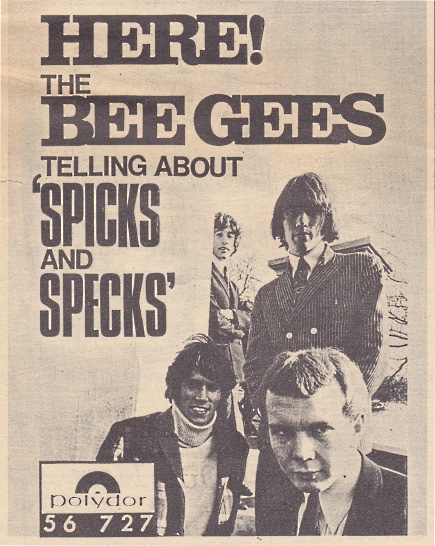
“I Don’t Know Why”, an album track off of Spicks and Specks (‘66) (the Bee Gees’ second studio album) was the first song credited to Robin Gibb. It is a wonderful Beatlesque ballad that wouldn’t seem out of place on Rubber Soul. (https://www.radioswissjazz.ch/en/music-database/musician/12020504912aea207b22cb3a8cb97aa34d75c/biography).

It was all made possible by the song “Spicks and Specks.” BeeGees.com says:

Spicks and Specks . . . [is] laden with rich harmonies and bittersweet lyrics, backed by delicate, predominantly acoustic instrumentation. Originally presented as ‘Monday’s Rain,’ the album’s title was ultimately changed to capitalize on the success of single “Spicks and Specks.” . . . the[ir] first hit . . . in Australia . . . . Yet by that point, The Bee Gees had already decided to uproot and move their career to the U.K.

https://www.beegees.com/music/discography/spicks-and-specks/

“Whilst at sea in January, 1967, they heard that “Spicks and Specks”, a song they had recorded in 1966, had gone to #1 in Australia.” (https://www.last.fm/music/Bee+Gees/+wiki)

And as Joe Marchese elaborates:

The catchy track made it to No. 3 in Sydney, staying in the Top 40 for 19 weeks, and in other areas of Australia reached pole position. . . . . [It] made such an impression that its release led to the group’s signing with Polydor in the U.K.; it became the group’s first single there. The Bee Gees’ new album, naturally, was titled after the hit song. Spicks and Specks used most of the tracks intended for an aborted LP entitled Monday’s Rain. This album was never issued outside Australia . . . . On January 3, 1967, the Bee Gees began their journey back to England. It’s hardly an exaggeration to state that “the rest is history” once they arrived.

https://theseconddisc.com/2013/01/18/morning-of-their-lives-bee-gees-original-australian-albums-reissued-on-cd-by-festival-label/

Check out the site’s new page: Stick It to the (Fish)Man: Feedback — the coolest comments I have received!

I have added a Facebook page for Brace for the Obscure 60s Rock! If you like what you read and hear and feel so inclined, please visit and “like” my Facebook page by clicking here.

Pay to Play! The Off the Charts Spotify Playlist! + Brace for the Obscure 60s Rock Merchandise

Please consider helping to support my website/blog by contributing $6 a month for access to the Off the Charts Spotify Playlist. Using a term familiar to denizens of Capitol Hill, you pay to play! (“relating to or denoting an unethical or illicit arrangement in which payment is made by those who want certain privileges or advantages in such arenas as business, politics, sports, and entertainment” — dictionary.com).

The playlist includes all the “greatest songs of the 1960’s that no one has ever heard” that are available on Spotify. The playlist will expand each time I feature an available song.

All new subscribers will receive a Brace for the Obscure 60s Rock magnet. New subscribers who sign up for a year will also receive a Brace for the Obscure 60s Rock t-shirt or baseball cap. See pictures on the Pay to Play page.

When subscribing, please send me an e-mail (GMFtma1@gmail.com) or a comment on this site letting me know an e-mail address/phone number/Facebook address, etc. to which I can send instructions on accessing the playlist and a physical address to which I can sent a magnet/t-shirt/baseball cap. If choosing a t-shirt, please let me know the gender and size you prefer.

Just click on the first blue block for a month to month subscription or the second blue block for a yearly subscription.

Gary Walker & the Rain — “The View”: Brace for the Obscure (60s rock)! — June 13, 2022

THE GREATEST SONGS OF THE 1960s THAT NO ONE HAS EVER HEARD

483) Gary Walker & the Rain — “The View”

“The View” is a stunning number from Album No. 1, one of Great Britain’s great lost pop psych albums — only it wasn’t really lost, as it was released in Japan, and it wasn’t really British, as it was led by a Yank. As Voltaire famously said, “[t]he Holy Roman Empire was neither Holy, nor Roman, nor an Empire.” As Richie Unterberger once said, the Walker Brothers “weren’t British, they weren’t brothers, and their real names weren’t Walker”.

What is the story here? Let’s go to Unterberger:

Californians Scott Engel, John Maus, and Gary Leeds, were briefly huge stars in England . . . . Engel and Maus were playing together in Hollywood when drummer Leeds suggested they form a trio and try to make it in England. And they did — with surprising swiftness, the[ “Walker Brothers”] hit the top of the British charts with “Make It Easy on Yourself” in 1965. “The Sun Ain’t Gonna Shine Anymore” repeated the feat the following year . . . . For a few months they experienced frenzied adulation almost on the level of the Beatles and the Stones . . . . [T]hey were far more pop than rock. . . . favor[ing] orchestrated ballads . . . emulat[ing] the Righteous Brothers . . . . In the intensely competitive days of 1967, the Walkers’ brand of pop suddenly become passé, and the group disbanded in the face of diminishing success and Scott’s increasingly fruitful solo career. Scott ran off a series of Top Ten British solo albums in the late ’60s, which have attracted a sizable cult with their idiosyncratic marriage of Scott’s brooding, insular songs and ornate orchestral arrangements. [see #396] Gary Walker released a few singles and an album with his group the Rain in a much harder-rocking guitar-oriented format.

https://www.allmusic.com/artist/the-walker-brothers-mn0000582024/biography

Vernon Joynson adds that:

[Gary Walker] was ousted in 1967. As Gary Leeds he’d been in the early Standells. Then in 1966 frustrated at his limited role in the [Walker Brothers] he began a solo career. His first two efforts were minor hits and then he formed Rain with former Cryin’ Shames guitarist Paul Crane and ex-Masterminds’ guitarist Joey Molland.

(The Tapestry of Delights Revisited)

And the Rising Storm elaborates:

[Album Number 1 is] a genuine lost album which has only recently seen the light of day outside Japan and which will come as a pleasant surprise to aficionados of Brit psych. Gary Leeds was only ever a third wheel to the Walker Brothers, a non-singing drummer thumping the tubs on live dates and TV appearances . . . . However, such was the impact of the Walkers in Europe and Japan that, when the trio folded, Gary was easily convinced by conniving manager Maurice King to put together a new band in England . . . . Allegedly Molland’s interview ran thus. Leeds: You look like Paul McCartney. Can you sing like him? Molland: Yes. L: Can you play guitar like Eric Clapton? M: Yes. L: You’re in. Serendipitously, he really could do both, besides proving an adept songwriter. . . . The band’s recording career kicked off with a passable cover of Spooky that . . . sold well [only] in Japan, where the Walkers had belatedly achieved godlike status. On the basis of this UK Polydor permitted them to record an album, but then inexplicably refused to release it. Only in Japan, where the band’s local label, Philips, was crying out for further product, did it hit the shelves . . . . On the ensuing tour of Japan the band were mobbed by teenage girls . . . . [T]he band called it a day just a year after coming together. Molland went on to be a cornerstone of Badfinger . . . .

http://therisingstorm.net/gary-walker-the-rain-album-no-1/

Finally, Vernon Joynson again:

[Album No. 1] only released in Japan and has long been established as one of the world’s rarest records . . . . It is thought to have been withdrawn from sale almost immediately because of Molland’s contractual commitments to The Iveys.

Check out the site’s new page: Stick It to the (Fish)Man: Feedback — the coolest comments I have received!

I have added a Facebook page for Brace for the Obscure 60s Rock! If you like what you read and hear and feel so inclined, please visit and “like” my Facebook page by clicking here.

Pay to Play! The Off the Charts Spotify Playlist! + Brace for the Obscure 60s Rock Merchandise

Please consider helping to support my website/blog by contributing $6 a month for access to the Off the Charts Spotify Playlist. Using a term familiar to denizens of Capitol Hill, you pay to play! (“relating to or denoting an unethical or illicit arrangement in which payment is made by those who want certain privileges or advantages in such arenas as business, politics, sports, and entertainment” — dictionary.com).

The playlist includes all the “greatest songs of the 1960’s that no one has ever heard” that are available on Spotify. The playlist will expand each time I feature an available song.

All new subscribers will receive a Brace for the Obscure 60s Rock magnet. New subscribers who sign up for a year will also receive a Brace for the Obscure 60s Rock t-shirt or baseball cap. See pictures on the Pay to Play page.

When subscribing, please send me an e-mail (GMFtma1@gmail.com) or a comment on this site letting me know an e-mail address/phone number/Facebook address, etc. to which I can send instructions on accessing the playlist and a physical address to which I can sent a magnet/t-shirt/baseball cap. If choosing a t-shirt, please let me know the gender and size you prefer.

Just click on the first blue block for a month to month subscription or the second blue block for a yearly subscription.

Nueva Democracia — “Hey, Hey”: Brace for the Obscure (60s rock)! — June 12, 2022

THE GREATEST SONGS OF THE 1960s THAT NO ONE HAS EVER HEARD

482) Nueva Democracia — “Hey, Hey

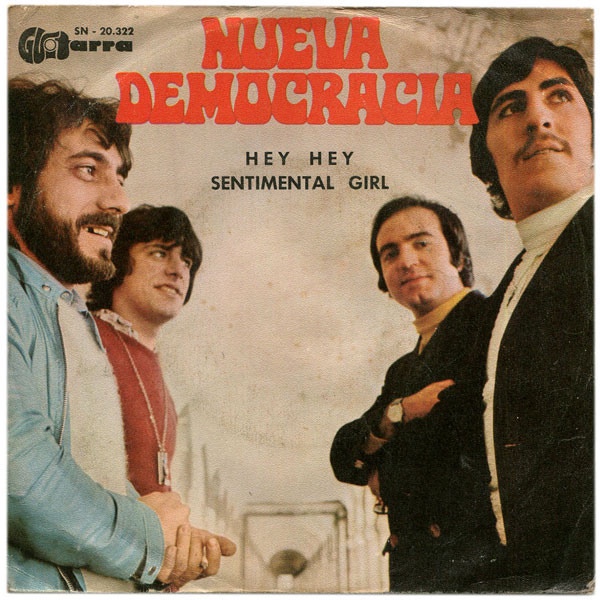
Shimmering sunshine pop from sunny Spain! Mundo & Mr. Toytown tell us that:

After winning the famous La Voz Del Mino radio show contest, they moved to Madrid to play some shows and record a 45 . . . . Once there, they changed their name to Los Posters and released a couple of soft pop Los Angeles styled 45s . . . in 1967. A couple of years later . . . [the band released] one . . . single under the new name Nueva Democracia . . . a name which anticipated [by] nearly seven years [Francisco] Franco’s dictatorship[‘s] end. Released in 1969, “Hey Hey” is a good example of the band’s innocent harmony-pop sound.

liner notes to Papagayo!: The Spanish Sunshine Pop & Popsike Collection

Check out the site’s new page: Stick It to the (Fish)Man: Feedback — the coolest comments I have received!

I have added a Facebook page for Brace for the Obscure 60s Rock! If you like what you read and hear and feel so inclined, please visit and “like” my Facebook page by clicking here.

Pay to Play! The Off the Charts Spotify Playlist! + Brace for the Obscure 60s Rock Merchandise

Please consider helping to support my website/blog by contributing $6 a month for access to the Off the Charts Spotify Playlist. Using a term familiar to denizens of Capitol Hill, you pay to play! (“relating to or denoting an unethical or illicit arrangement in which payment is made by those who want certain privileges or advantages in such arenas as business, politics, sports, and entertainment” — dictionary.com).

The playlist includes all the “greatest songs of the 1960’s that no one has ever heard” that are available on Spotify. The playlist will expand each time I feature an available song.

All new subscribers will receive a Brace for the Obscure 60s Rock magnet. New subscribers who sign up for a year will also receive a Brace for the Obscure 60s Rock t-shirt or baseball cap. See pictures on the Pay to Play page.

When subscribing, please send me an e-mail (GMFtma1@gmail.com) or a comment on this site letting me know an e-mail address/phone number/Facebook address, etc. to which I can send instructions on accessing the playlist and a physical address to which I can sent a magnet/t-shirt/baseball cap. If choosing a t-shirt, please let me know the gender and size you prefer.

Just click on the first blue block for a month to month subscription or the second blue block for a yearly subscription.

49th Parallel — “Lazerander Filchy”: Brace for the Obscure (60s rock)! — June 11, 2022

THE GREATEST SONGS OF THE 1960s THAT NO ONE HAS EVER HEARD

481) 49th Parallel — “Lazerander Filchy

Another song from Calgary’s 49th Parallel (see #367). This is the one and only psych classic about a creepy taxidermist (who might possibly be applying his craft to people) — which one would think to be a much more popular subject for lysergic inquiry. Anyway, it is totally awesome and sounds like it came straight ‘outta London.

Michael Panontin explains:

Calgary’s torch bearers in the great sixties rock sweepstakes were 49th Parallel, whose 1969 chart success, ‘Twilight Woman’, garnered them a few deserved rays of limelight. . . . With MGM affiliate Maverick agreeing to handle US distribution, the single managed to tweak a few charts south of the border. Which of course gave Maverick the leeway to issue an entire LP, The 49th Parallel, an oddly schizophrenic mix of sunshine pop, Anglo lysergia and the gruffer acid-rock sounds of the era. . . . The gentlest and ultimately most successful tracks on The 49th Parallel were written by a mysterious Don Hockett, like . . . the Tomorrow-esque psych of ‘Lazerander Filchy’. ‘

http://www.canuckistanmusic.com/index.php?maid=69

The Museum of Canadian Music adds:

[They] were originally known in the mid-60’s as a popular bar band by the name of The Shades Of Blond. With a stifling and musically limiting Calgary club scene they were never able to get farther than having one single — 1966’s “All Your Love”. . . . Throughout 1968 and parts of 1969 they toured throughout North America with an ever fluctuating roster. . . . [T]hey did hit and run recording sessions which bore several singles for Venture Records including “Twilight Woman” that managed seven weeks on the CHUM charts with a peak position of #16 in April 1969, and its follow-up, “Now That I’m A Man”, in September 1969 which managed a modest 3 week ride on the CHUM charts and a peak position of #22. . . . A full-length album was hastily assembled from singles and studio outtakes because the line-up was continually fluctuating and new recordings were impossible to conduct. . . . Eventually the band changed its name to Painter and released one album before mutating into the hard rock act Hammersmith who would finally succumb in the late ’70’s after two albums on Mercury Records.

Canada Pop Encyclopedia, http://citizenfreak.com/titles/264434-49th-parallel-st

Check out the site’s new page: Stick It to the (Fish)Man: Feedback — the coolest comments I have received!

I have added a Facebook page for Brace for the Obscure 60s Rock! If you like what you read and hear and feel so inclined, please visit and “like” my Facebook page by clicking here.

Pay to Play! The Off the Charts Spotify Playlist! + Brace for the Obscure 60s Rock Merchandise

Please consider helping to support my website/blog by contributing $6 a month for access to the Off the Charts Spotify Playlist. Using a term familiar to denizens of Capitol Hill, you pay to play! (“relating to or denoting an unethical or illicit arrangement in which payment is made by those who want certain privileges or advantages in such arenas as business, politics, sports, and entertainment” — dictionary.com).

The playlist includes all the “greatest songs of the 1960’s that no one has ever heard” that are available on Spotify. The playlist will expand each time I feature an available song.

All new subscribers will receive a Brace for the Obscure 60s Rock magnet. New subscribers who sign up for a year will also receive a Brace for the Obscure 60s Rock t-shirt or baseball cap. See pictures on the Pay to Play page.

When subscribing, please send me an e-mail (GMFtma1@gmail.com) or a comment on this site letting me know an e-mail address/phone number/Facebook address, etc. to which I can send instructions on accessing the playlist and a physical address to which I can sent a magnet/t-shirt/baseball cap. If choosing a t-shirt, please let me know the gender and size you prefer.

Just click on the first blue block for a month to month subscription or the second blue block for a yearly subscription.

Jun Mayuzumi — “Black Room”: Brace for the Obscure (60s rock)! — June 10, 2022

THE GREATEST SONGS OF THE 1960s THAT NO ONE HAS EVER HEARD

480) Jun Mayuzumi— “Black Room”

The French yé-yé girls had nothing on Japan’s Jun Mayuzumi. Sheila Burgel tells us that:

Once the [Group Sound] boom hit . . . “Koi No Hallejujah” [was] a monster hit for a little-known singer named Jun Mayuzumi. Released in February 1967, “Koi No Hallejujah” was the girl-pop manifesto. It replaced orchestras with organs and shrill electric guitars, upped the volume and vibrato, and showcased a yearning, mournful vocal that came to epitomise the girl-pop sound. Before Jun Mayuzumi became synonymous with Japanese beat girl, she cut her teeth as a pre-teen singing in Toyko’s jazz cafes, at army bases and as the house singer in a band . . . . At age 14, she signed to Victor Records under her birth name of Junko Watanabe and released half-baked Euro-pop covers. When the three singles failed to chart, she changed her name, cut all her hair off Twiggy-style, signed up with [a] talent agency . . . and landed a deal with the Capitol imprint of Toshiba Records. The success of “Koi No Hallelujah”, her first Capitol release, established Mayuzumi as the “queen of Japanese beat” . . . . [H]er two best records . . . undoubtedly [include the B-side] “Black Room” [with] booming bass lines, a tough vocal and a dancefloor readiness . . . .”

liner notes to Nippon Girls: Japanese Pop, Beat & Bossa Nova 1966-70 CD comp

Check out the site’s new page: Stick It to the (Fish)Man: Feedback — the coolest comments I have received!

I have added a Facebook page for Brace for the Obscure 60s Rock! If you like what you read and hear and feel so inclined, please visit and “like” my Facebook page by clicking here.

Pay to Play! The Off the Charts Spotify Playlist! + Brace for the Obscure 60s Rock Merchandise

Please consider helping to support my website/blog by contributing $6 a month for access to the Off the Charts Spotify Playlist. Using a term familiar to denizens of Capitol Hill, you pay to play! (“relating to or denoting an unethical or illicit arrangement in which payment is made by those who want certain privileges or advantages in such arenas as business, politics, sports, and entertainment” — dictionary.com).

The playlist includes all the “greatest songs of the 1960’s that no one has ever heard” that are available on Spotify. The playlist will expand each time I feature an available song.

All new subscribers will receive a Brace for the Obscure 60s Rock magnet. New subscribers who sign up for a year will also receive a Brace for the Obscure 60s Rock t-shirt or baseball cap. See pictures on the Pay to Play page.

When subscribing, please send me an e-mail (GMFtma1@gmail.com) or a comment on this site letting me know an e-mail address/phone number/Facebook address, etc. to which I can send instructions on accessing the playlist and a physical address to which I can sent a magnet/t-shirt/baseball cap. If choosing a t-shirt, please let me know the gender and size you prefer.

Just click on the first blue block for a month to month subscription or the second blue block for a yearly subscription.

Jan & Dean — “Mulholland”: Brace for the Obscure (60s rock)! — June 9, 2022

THE GREATEST SONGS OF THE 1960s THAT NO ONE HAS EVER HEARD

479) Jan & Dean — “Mulholland”

In my mind, this is the greatest ode to a street in song since “Penny Lane.” Terry Staunton sees “a formidable sophistication to . . . the epic LA poetry of Mulholland.” (https://recordcollectormag.com/reviews/album/carnival-of-sound). Domenic Priore & Mark Moore explain that:

“Mullholland” equates the zenith drive atop Hollywood Hills as a celestial experience, complemented by a sitar and a raga “snake charmer” motif, giving the song a magic-carpet feel. It’s then all brought down to Earth by a girl jumping not onto a flying rug, but into Jan’s car. The extended stereo mix . . . features some of Jan & Dean’s stock-in-trade comedy with Jan arguing with police before breaking into a bit of “Yes Sir, That’s My Baby.”

liner notes to the Carnival of Sound CD

Anyway, the song comes from the fabled “lost” Carnival of Sound album, unreleased until 2010 (see #376). Gold Mine Magazine and Endless Summer Quarterly enthuse that:

Jan Berry’s Carnival Of Sound — a collection of music he finished in 1968 (after his near-fatal automobile accident on April 12, 1966) — is astonishing . . . . This album will close a previously mythic chapter and invigorate Jan Berry’s musical legacy. . . . This is psychedelic pop at its best.

https://www.bear-family.com/jan-dean-carnival-of-sound-plus-deluxe-edition-the-legendary-unissued-album-cd.html

Bruce Eder adds that:

[I]f not as well-known as Brian Wilson’s Smile, Carnival of Sound is just as tantalizing a “lost” artifact of the psychedelic ’60s . . . . What is here is mostly fun, and beautifully accomplished, with superb playing and excellent singing; and the production is, at times, stunning, and also far more self-consciously ambitious than prior Jan and Dean releases . . . . Jan & Dean had always managed to quietly impress listeners by slipping these beautifully produced jewels past them as pop music, but on Carnival of Sound, they were very obviously calling more attention to the layers of sound swirling and shifting below the surface . . . .

https://www.allmusic.com/album/carnival-of-sound-mw0001977238

Terry Staunton adds that:

The Beach Boys are rightly held in awe for making the journey from the throway Surfin’ Safari to the eloquent genius of Pet Sounds in less than five years, but they weren’t the only sunkissed Californians pushing the envelope. History has often overlooked Jan & Dean, but Jan Berry always hungered for the teen symphonies so commonly associated with Brian Wilson. The duo’s career was put on hold after Berry’s horrific car crash in 1966, but he continued to piece together the components of Carnival Of Sound during his long recovery.

https://recordcollectormag.com/reviews/album/carnival-of-sound

Check out the site’s new page: Stick It to the (Fish)Man: Feedback — the coolest comments I have received!

I have added a Facebook page for Brace for the Obscure 60s Rock! If you like what you read and hear and feel so inclined, please visit and “like” my Facebook page by clicking here.

Here is the extended stereo mix:

Pay to Play! The Off the Charts Spotify Playlist! + Brace for the Obscure 60s Rock Merchandise

Please consider helping to support my website/blog by contributing $6 a month for access to the Off the Charts Spotify Playlist. Using a term familiar to denizens of Capitol Hill, you pay to play! (“relating to or denoting an unethical or illicit arrangement in which payment is made by those who want certain privileges or advantages in such arenas as business, politics, sports, and entertainment” — dictionary.com).

The playlist includes all the “greatest songs of the 1960’s that no one has ever heard” that are available on Spotify. The playlist will expand each time I feature an available song.

All new subscribers will receive a Brace for the Obscure 60s Rock magnet. New subscribers who sign up for a year will also receive a Brace for the Obscure 60s Rock t-shirt or baseball cap. See pictures on the Pay to Play page.

When subscribing, please send me an e-mail (GMFtma1@gmail.com) or a comment on this site letting me know an e-mail address/phone number/Facebook address, etc. to which I can send instructions on accessing the playlist and a physical address to which I can sent a magnet/t-shirt/baseball cap. If choosing a t-shirt, please let me know the gender and size you prefer.

Just click on the first blue block for a month to month subscription or the second blue block for a yearly subscription.

Minnie Riperton — “Rainy Day in Centerville”: Brace for the Obscure (60s rock)! — June 8, 2022

THE GREATEST SONGS OF THE 1960s THAT NO ONE HAS EVER HEARD

478) Minnie Riperton — “Rainy Day in Centerville”

Today, I feature a second track from Minnie’s glorious debut album (see #23), the soaring “Rainy Day in Centerville.” Derek Anderson says that:

[T]he lyrics have a wistful, melancholy sound when sung by Minnie. . . , [who’s] vocal veers between a tender style, to one where she’s able to demonstrate her power and five and a half octave range. However, she’s just as effective when she sings tenderly, resulting in a wistful, melancholy sound. Later in the track, there’s some clever interplay with the piano and horns, with the strings floating above a crescendo of drama builds and builds, giving way to Minnie’s powerful, yet ethereal and beautiful vocal. This was a masterstroke on Charles Stepney’s, resulting in a hugely, memorable and impressive ending to the song. . . .

https://dereksmusicblog.com/2011/12/17/minnie-riperton-come-to-my-garden/

Jason Ankeny relays some of Minnie Riperton’s history:

The tragic death of 31-year-old Minnie Riperton in 1979 silenced one of soul music’s most unique and unforgettable voices. Blessed with an angelic five-octave vocal range, she scored her greatest commercial success with the chart-topping pop ballad “Lovin’ You.” . . . In 1968, Riperton was installed as the lead vocalist of the psychedelic soul band Rotary Connection, which debuted that year with a self-titled LP on Cadet Concept. The singles “Amen” and “Lady Jane” found a home on underground FM radio, but the group failed to make much of an impression on mainstream outlets. While still a member of the band, Riperton mounted a solo career. Teaming with husband and fellow composer Richard Rudolf, and Rotary Connection catalyst Charles Stepney as co-writer, producer, and arranger, she issued her brilliant debut, Come to My Garden, in 1970. . . . [which] is in many respects her finest hour . . . . couch[ing] her miraculous voice in the elegant arrangements of the great Charles Stepney, striking a perfect balance between romantic melodrama and sensual nuance. Call Stepney’s singular approach “chamber soul”–the nimble melodies and insistent grooves swell with orchestral flourishes, while the jazz-inspired rhythms (courtesy of Ramsey Lewis’ group) at times evoke Van Morrison’s masterpiece Astral Weeks. Stepney creates the ideal backdrop for Riperton’s soaring vocals . . . .

https://www.allmusic.com/artist/minnie-riperton-mn0000500889/biography; https://www.allmusic.com/album/come-to-my-garden-mw0000220490

Derek Anderson contemplates that:

[I]t’s always amazed me how many great albums fail to be a commercial success when they’re released. When Come To my Garden was released, it was to critical acclaim. . . . [The album is full of] lush, orchestral soundscapes, with Minnie’s ethereal, beautiful voice sitting above them. . . . Sadly, on its release in April 1970, [it] peaked at number 160 on the US Billboard 200. . . . Maybe the album was too sophisticated . . . . a magical, musical masterpiece full of the lushest orchestral soundscapes, with the graceful, elegant and ethereal voice of Minnie Riperton taking centre-stage.

https://dereksmusicblog.com/2011/12/17/minnie-riperton-come-to-my-garden/

Check out the site’s new page: Stick It to the (Fish)Man: Feedback — the coolest comments I have received!

I have added a Facebook page for Brace for the Obscure 60s Rock! If you like what you read and hear and feel so inclined, please visit and “like” my Facebook page by clicking here.

Pay to Play! The Off the Charts Spotify Playlist! + Brace for the Obscure 60s Rock Merchandise

Please consider helping to support my website/blog by contributing $6 a month for access to the Off the Charts Spotify Playlist. Using a term familiar to denizens of Capitol Hill, you pay to play! (“relating to or denoting an unethical or illicit arrangement in which payment is made by those who want certain privileges or advantages in such arenas as business, politics, sports, and entertainment” — dictionary.com).

The playlist includes all the “greatest songs of the 1960’s that no one has ever heard” that are available on Spotify. The playlist will expand each time I feature an available song.

All new subscribers will receive a Brace for the Obscure 60s Rock magnet. New subscribers who sign up for a year will also receive a Brace for the Obscure 60s Rock t-shirt or baseball cap. See pictures on the Pay to Play page.

When subscribing, please send me an e-mail (GMFtma1@gmail.com) or a comment on this site letting me know an e-mail address/phone number/Facebook address, etc. to which I can send instructions on accessing the playlist and a physical address to which I can sent a magnet/t-shirt/baseball cap. If choosing a t-shirt, please let me know the gender and size you prefer.

Just click on the first blue block for a month to month subscription or the second blue block for a yearly subscription.